Back to selection
K. Austin Collins Salutes Frederick Wiseman
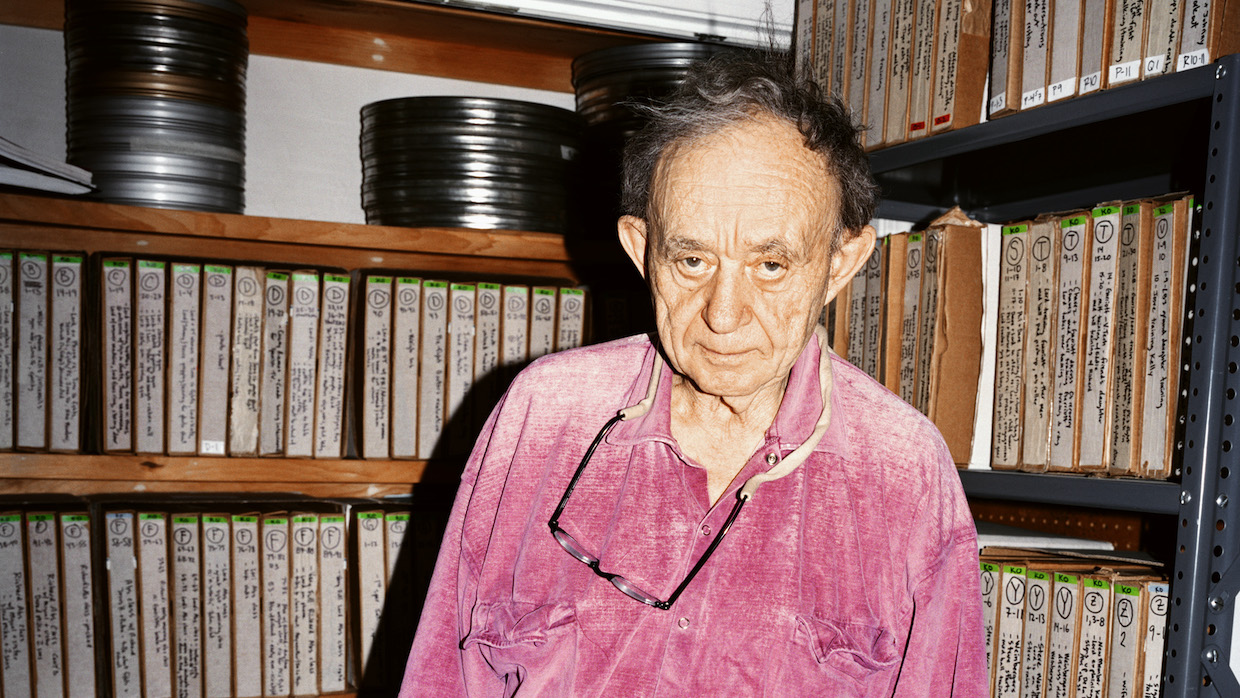 Photo by Kevin Trageser/Redux
 I think of the work of Frederick Wiseman, and my mind is drawn, immediately, to the faces. The blank stare of a monkey whose head, stem still attached, has been painstakingly severed from its body, for the sake of science, in Primate (1974). Young Black and Latino students in Harlem parsing the immediate ramifications of the Rodney King beating in High School II (1994). The sinewed despair that confronts us as the working-class people of Titicut Follies (1967), Hospital (1970), Welfare (1975), Public Housing (1997), In Jackson Heights (2015), and so many other of Wiseman’s films navigate the life-and-death intricacies of institutions designed to cannibalize, rather than alleviate, their suffering. The speechless shock of a Black woman whose brutal arrest, in Law and Order (1969), leaves her half-nude before a film camera whose cool dispassion only barely masks the filmmaker’s horror. The artists and performers of Ballet (1995), Crazy Horse (2011), and Menus-Plaisirs—Les Troisgros (2023), pushed to the limits of their skill and dedication by art forms—dance, cuisine—whose payoffs are almost entirely ephemeral and necessarily imperfect, and all the more poignant for that fact.
These figures are burned into my mind as indelibly as any timeless Old Hollywood titan. But they aren’t stars, and they aren’t characters. They’re people. In the work of Frederick Wiseman—who died at the age of 96, leaving behind more than a half century of towering, inimitable documentary art—this is a profound premise, no mere ordinary fact. He became known and will go down in history as one of our great documenters of institutions as an idea, be they public institutions—welfare offices, shelters, hospitals, police forces, and the like—or private ones, like Madison Square Garden and the ballet company of the Royal Paris Opera.
And yet, throughout his career, he has reminded us—sometimes with acerbic force, as in his early exposés, and sometimes with a leisurely, near-luxuriant sense of immersion, as in many of his later epic studies—that at the core of each of these institutions is a group of people: doctors, patients, executives, social workers, students, middle- and working-class people of every stripe, queer activists, elderly people with nothing but time and memory on their hands. And at every level, stitched into the backbone of every one of his documentaries, there is talk. There is discourse. There is a sense of institutions that, far from abstract and monolithic, can be simplified to the decisions made by eloquent people in quiet rooms or in police cruisers between incidents of violence. Far from mere victims, the women of Domestic Violence (2001), for example, are talking—narrating themselves in intake meetings and group therapy to such a degree that we come to understand the domestic violence shelter not only as a safe haven from physical violence but also as a place where language can finally happen, where expression might finally be free.
For the bulk of his career and until his death, Wiseman seemed far enough outside the mainstream to always feel like a well-kept secret for the initiated—your favorite director’s favorite director—which is perhaps why his methods have almost become the stuff of myth. Those who know his work know the routine well: negotiating full and unmitigated access to his subjects; filming hundreds of hours of footage over four to six weeks of deep immersion; editing that morass of incidents into an incisive collection of scenes, conversations, and images; stitching them onto an implied dramatic backbone that often travels from morning to night, giving a sense of a “day in the life,” all of it without talking heads or narration to guide us, and all of it while trusting that his eye for detail and character, which was indeed extraordinary, would carry us through.
And they did. His films were never boring, because the people within them, edited so capably into a patchwork microcosm by his deft hand, were never boring. Speech is our fundamental political act. Wiseman’s cinema has taught me this. In a current cinema landscape rife with corporate docufictions and cookie-cutter murder mysteries, where nonfiction filmmaking as a sustainably independent art feels more fragile than ever, Wiseman’s work seems only more alien for being predicated almost entirely on what, fundamentally, makes us human. I often joke with other Black film critics that Wiseman was one of our best Black filmmakers—not because he was Black himself, which of course he wasn’t, but because the images he has given us of the Black working class, and then some, are nearly without peer.
The sublime trick of his work is that his films, simply titled almost to the point of parody, were never merely about what they were “about.” High School I (1968) and II (1994) are extraordinary studies of their political eras—Vietnam and early-1990s upheavals in racial discontent, respectively—without ever needing to announce themselves as such. Monrovia, Indiana (2018) is one of the key texts of the Trump-era rural America, but so delicate in its approach that saying as much almost feels crass.
When Wiseman died, the first thing I thought of was a moment from late in City Hall (2020), Wiseman’s study of Marty Walsh–era Boston politics. It is a scene in which pest control visits a man whose apartment has been infested with rodents. The man’s shame is palpable, and because he appears so late in the film, it’s impossible for the audience not to bear witness to all the social, structural, and tragic implications of his pain. It’s a moment of tension: between the systems we bear up by the brunt of being citizens and the systems, those same institutions, bearing down on us. That is the tension at the heart of Wiseman’s work. It’s the idea he plants in us merely by taking us there, to the scene of this man’s shame, at exactly the right moment, using exactly the right images. An entire world of discourse, politics, and implication exploding within an instant. That was Wiseman. Cinema will be worse off without him, but it is far better for what he gave us while he was here.
Jacob Burns Film Center will screen 12 of his documentaries in their series “Frederick Wiseman’s America,” which runs from April 8 to May 3. For additional information and tickets, visit their website.