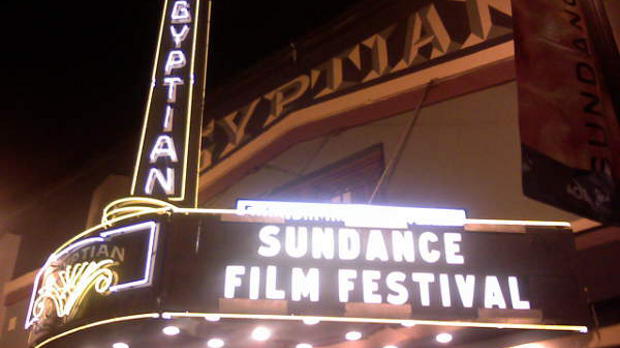
Sundance Responses

“THE WORDS” | directors Brian Klugman & Lee Sternthal

Friday, January 27th, 2012

[PREMIERE SCREENING: Friday, January 27  6:30 pm –Eccles Theatre, Park City]

There are so many reasons why we chose film as our medium to tell stories.   The fact is we’re children of our culture (how could we not be?) a culture of the mash up: of so many forms of expression constantly mixing and intertwining in all of our daily lives.  Well, film is the only medium where you get to combine so many of these forms of expression simultaneously: literature, music, photography, visual art and theater, all in your own unique way to create a singular vision that can reflect life, contemplate it and, if you’re lucky, for a moment even crystallize it.

There’s the joys and trials of actually making the film, the constant planning, the problem solving, the limitations you encounter before, during, and after production, and the re-imagining these limitations force you to do that constantly keeps you fresh, sharp and creative in trying to tell your story in the most compelling way possible.  This is to say that it is often the most frustrating difficulties of making a film that lead to its greatest joys.  When you can say that about your chosen field, that’s a pretty cool job.

Then there’s the communal aspect: in making a film you’re constantly being challenged, surprised and inspired by so many interesting, talented people every day as you collaborate to bring this vision to life.  No matter how simple or complicated, playful or important the project may seem, there’s always that joy of creating with friends or colleagues that, when all is said and done, goes back to the simplest days of being children.

Also, with film you have an opportunity to play with time in ways that, obviously, you just can’t in life (move forwards, backwards, even stop time) to make sense of things, to make amends, to speak to issues that are important to you or even just for the sheer joy of it.  Because of this, in many ways, making a film is the closest you can come to literally creating dreams.  Since The Read the rest

“CALIFORNIA SOLO” | director, Marshall Lewy

Wednesday, January 25th, 2012

[PREMIERE SCREENING: Wednesday, January 25 9:45 pm –EcclesTheatre, Park City]

I remember watching the end of Hannah and her Sisters as a teenager, when Woody Allen finds out he’s not going to die from a terminal illness and then fails at a suicide attempt. How does he find the will to live again? He walks past a theater where a Marx Brothers comedy is playing, he slips in and loses himself in the magic of Duck Soup, and all his problems melt away.

Of course, right? I mean, what better way for a person to celebrate life than to go sit in a dark room in the middle of the day for two hours and watch other people hit one another over the head on a giant screen?

I used to get choked up at the end of Hannah and her Sisters every time I watched it – which was far more frequently than your average teenager, by the way – because I identified with how Woody Allen feels about movie-going at that moment. I found no better cure-all than to slip into a sparsely crowded screening of some obscure film at the Brattle or Film Forum, and get lost in it. I wanted to make movies like the movies I loved when I grew up.

But following that idyllic dream into adulthood turns out to be a somewhat masochistic choice.  I bet every filmmaker at Sundance can attest that it’s hard to get a movie made, it can be tough to make a living as an independent filmmaker, and when you are lucky enough to make a film, it doesn’t quite turn out the way you thought it would. There’s very little about the whole thing that’s romantic.

I don’t even get lost in movies the way I used to, and that’s partly because now I’m a person who makes them. I’m jealous of people who can still be transported by a movie, their problems melting away. Instead of movie magic, I see shot selections and story beats and what equipment they had.

My romantic attachment to movies … Read the rest

“PRICE CHECK” | director, Michael Walker

Wednesday, January 25th, 2012

[PREMIERE SCREENING: Wednesday, January 25 6:30 pm –Eccles Theatre, Park City]

When you are in the film business, someone, let’s say your dentist, will inevitably tell you a story that they think is a great idea for a movie. But they don’t know how to write a script, they just know how to clean teeth, so they want you to write it for them. If I had an idea that I thought would make a good novel, I would tell it to the poor guy who made the mistake of telling me that he was a novelist, because I don’t know how to write a novel.  I work in film, so I write screenplays, and, when I can, I direct them. I don’t really have ideas and then wonder which medium would best suit the story. When the idea for Price Check came, I wrote the script, and, eventually, directed it.

When I was young, I wanted to be an actor. I can’t remember when I first heard the word “director”, but at some point I became aware that there was a process of making a film, and from then on, I was hooked.  Like most people who work in film, I got caught up in the magic of it all. It’s an amazing thing to walk into a dark room for two hours and be transported into another world, and go on an emotional journey with characters that you get to know and love.

One of the things I love about film is that it can be so many different things: funny, serious, arty, scary, low brow. There is an idea that pure cinema is silent, that the images alone need to tell the story, but this kind of thinking always bothered me.  There are films, like the Marx Brothers films, that aren’t visual films, but are as pure as cinema gets.  Price Check is a talky film, but it’s a visual film as well.  Every shot was planned and storyboarded, some of the sets are abstract, the acting is heightened – all of this is part of the … Read the rest

“GYPSY DAVY” | director, Rachel Leah Jones

Tuesday, January 24th, 2012

[PREMIERE SCREENING: Tuesday, January 24, 3:00 pm –Yarrow Hotel Theatre, Park City]

I’m not an independent filmmaker; so-called independent filmmakers—all the more so documentarians—are some of the most dependent people around. We depend on funders and characters, on permission-givers and gatekeepers, on our own (free) will, determination and hubris—not to mention on the weather. A film teacher I once had gave me the one really truly valuable lesson in all my MFA: “You want to make a movie?” she asked us. Yes, we nodded. “Then go out and tell everyone you know that you’re going to make a movie.” Otherwise, she explained, you’ll never make it to the finish line. In other words, let your ego (read: the fear and potential shame of not realizing what you set out to do) lead the way. And it’s so true. There you are, a single mother (regardless of how many co-producers you arm yourself with)—the filmmaker-progenitor, male or female, will always be a single mother; the kind who nobody knocked up; the kind who voluntarily walked into the sperm bank of creative ideas and impregnated themselves with a film. “You’ll fall in and out of love with your movie so many times, you won’t know how to begin, let alone end,” the professor of production continued… To which I would add, just like with children: you also won’t know where you end and your film begins…

Nevertheless, I make documentaries because I LOVE them—a good doc inspires like nothing else—but also because it seems I just wasn’t daring enough to choose an easier, cheaper, less risky medium to “do my thing.” I don’t make documentaries because I believe in “reality” as such, but because I’m a sucker for it’s narrative impact—especially when it is “subjectively” rather than “objectively” told. I’m a political animal and the documentary, one of the “discourses of sobriety,” as Bill Nichols so aptly put it, is my “drug of choice.” I’m a girl who feels compelled to name things, to “speak truth to power,” knowing full well that truth and power are relative. And once I start making a … Read the rest

“VALLEY OF SAINTS” | director, Musa Syeed

Monday, January 23rd, 2012

[PREMIERE SCREENING: Monday, January 23, 6:00 pm –Yarrow Hotel Theatre

My parents aren’t big moviegoers. In their nearly 40 years in America, they can probably count the number of times they’ve gone to a theater on one hand. So, when I was 8 years old, I was surprised when they decided to take the family out to the movies for the first time. But while other kids got to see Aladdin or Home Alone 2, my parents sat us down to watch Spike Lee’s Malcolm X.

In one of the many scenes that stuck with me, Malcolm is able to disperse a large, angry crowd of followers with a simple point of his finger. When they follow his orders, a police officer remarks, “No one man should have all that power.”

I was drawn to the power of that man but also to the power of the man behind the camera. Spike brought to life characters and stories that I wouldn’t otherwise know, helping me create a personal relationship with someone I could never meet. Cinema’s immersive nature allowed me to see from Malcom’s perspective and broadened how I imagine the world.

Valley of Saints reimagines the conflict zone of Kashmir, allowing audiences to experience the beauty and decay of the land my parents left.  Immersing audiences in this unique world, the film tells a story of love in the face of destruction.

My parents still don’t go to too many movies. But I’m pretty sure they’ll come out to see this one.


Read the rest

“THE LAST ELVIS” | director, Armando Bo

Monday, January 23rd, 2012

[PREMIERE SCREENING: Monday, January 23, 8:30 pm –Prospector Square Theatre, Park City]

I’m a third generation of filmmakers. When I was a boy I used to visit the sets of my father and grandfather. I worked as an extra, in production, in location scouting, in direction. I cannot say exactly why I do it. I only know that I enjoy it and I don’t see myself doing anything else.

I believe that cinema, being a combination of most of the other arts, if it is well executed, it is without a doubt the art that goes deeper and mobilizes more different feelings. It is also the most difficult to do because having so many people involved makes it easy to fail in different areas: the script, acting, music, editing, direction. If you are not aware of everything that is going on around you, there could be unexpected results that seem out of mood or that tell something that has nothing to do with what one had planned.

And in this modern world I believe that cinema is still the job of a craftsman, even though today media is mostly digital. You have to do it little by little, step by step, with complete dedication.

The Last Elvis is a movie that talks about identity, about the lack of character, about molding our personalities with what we see in others. It is the intimate story of a man who lives his life imitating another, who even becomes to believe that he is that other, and this affects his family and specially his daughter. This man has a reality that surrounds him and a dream to achieve. It is a movie that plays different notes and has different moods. This is why I think that cinema was the best way to tell it, because it allowed me to mix Elvis’ music with this reality that has nothing to do with Elvis. The reality where Carlos Gutierrez lives, the leading character. Cinema allows me to visually narrate Carlos madness, and also to show how he manages to achieve his dream, that thing he … Read the rest

“THE IMPOSTER” | director, Bart Layton

Monday, January 23rd, 2012

[PREMIERE SCREENING: Monday, January 23, 5:30 pm –Prospector Square Theatre, Park City]

As a documentary-maker you could wait a lifetime to happen upon a story as extraordinary as this one. From the moment I heard about it it sounded like something that could hardly have taken place in the real world – a Frenchman successfully steals the identity of a missing Texan boy and begins a new life within the boy’s family posing as their child? If it were a work of fiction it would seem far-fetched. And from this sparked the need to find out more – about the man capable of perpetrating such a crime and the family capable of becoming victims to it.

When I met with the imposter, he was immediately fascinating. At once charming and off-putting, childlike and jaded, someone who seemed to have lived his life in a fantasy that suited him better than the life he was born into – and it was all too easy to get sucked in, wanting to believe him despite knowing he was a convicted and pathological liar, wanting to hear him tell his story in his own words. But having met him – heard his thick accent, seen his olive skin, dark hair and dark brown eyes, it seemed impossible that at the age of 23 he could have convinced authorities that he was an American 16-year-old and much less, convinced a family that he was their blonde-haired, blue-eyed all-American boy.

I wondered if perhaps the Imposter was not the story, but was rather a way in to a more interesting story about deception and self-deception and the ability people have to construct their own truths. Other fascinating characters emerged – many of whom seemed better suited to a Coen Brothers film than to the real world. It was hard to hear the interviewees describe these events without feeling like they were recounting the plot to a movie and that seemed to unlock something of how we might go about telling this story. There would be no single truth, no way of “getting it right”, so my … Read the rest

“5 BROKEN CAMERAS” | directors, Emad Burnat & Guy Davidi

Monday, January 23rd, 2012

[PREMIERE SCREENING: Monday, January 23 9:00 pm –Yarrow Hotel Theatre, Park City]

Co-Director Emad Burnat:

I been filming during the last 7 years so I sow many films been done about the wall and the occupation the conflict in palestine but most of these films by film makers or directories who came from out said palestine they didn’t live the experience so after more than 5 years of documenting and filming the struggle in my village bilin and the villages around

I decided to make film from point of me because I live here and make this from my feeling the really life and thought that I have strong story to tel ,it’s not like directors who come to make films fore money or to be famous so I want to

Show the audience my experience and how I live how my family live and feel and my village the purpose to make film is to reach the audience in the world to make them feel and affect in said to make change.

co-director Guy Davidi:

I don’t remember ever really choosing to be a filmmaker; it was a natural thing more then a calculated decision. Making 5 Broken Cameras was not the right or better medium in any case. But the choice to make it was so organic that I almost forget it was a choice.

I made many mistakes for my first decade of filmmaking. After turning 17 when I made my first short film, every decision to make another film was calculated and elaborated. In each film there was an enormous amount of energy invested, and there was a strong initiative. But, if I managed to get a decent film out of the overall experience, I finished feeling bruised and empty.

I think many great filmmakers just stop making films because there is so much effort and you are under so much pressure, and self-criticism. But the worst thing is that all the people around you keep convincing you that this is the way it should be. So it kills your love to simply express yourself with … Read the rest

“THE SURROGATE” | director, Ben Lewin

Monday, January 23rd, 2012

[PREMIERE SCREENING: Monday, January 23, 12:15 pm –Eccles Theatre, Park City]

My mother insisted I pursue a career as a lawyer so, when the opportunity to study filmmaking arose and I could put some distance between us – physically and philosophically – I leapt at it.  In later years, my mother joined an extras casting agency and became a recognized face, and ironically, we discovered we had a common passion.


http://www.imdb.com/title/tt1866249/… Read the rest

“SLAVERY BY ANOTHER NAME” | director, Sam Pollard

Monday, January 23rd, 2012

[PREMIERE SCREENING: Monday, January 23 Noon –Temple Theatre, Park City]

I am a filmmaker because as a young man much of my time was spent watching a television show titled The Million Dollar Movie. It was broadcast on the local station WOR Channel 9. They happen to own the RKO Pictures film catalogue and they would show a film all week. The one film that I saw many times that had a tremendous impression on me was Orson Welles’ Citizen Kane. So watching that show every week and seeing that film and others such as Gunga Din, Fort Apache, His Kind of Woman shaped much of my filmic sensibility. From that point in my life to now I love watching movies all types of moves. My palette has expanded to include not only American films but also foreign films, not only narrative films but also documentaries and experimental films. I love films, great ones, mediocre ones and even bad ones. I always learn something from any of them and can watch a movie anytime and any place.

Why is film, as opposed to all of today’s other forms, the medium for your story? We live and breathe in a visual age and what amazes me as I live now have entered my sixth decade is how people are so visually astute to everything from commercials to feature films. I teach filmmaking at NYU and the students we now have did not grow up on books but film and so much of how they see the world is based on their filmic experiences. There is good and bad to this because as much as I love film I want people to be able to see the world not only through films but books, art, and music. All of these things are vital to making well-rounded human beings and great filmmakers… Read the rest

VOD CALENDAR

Filmmaker's curated calendar of the latest video on demand titles.
Contagion The Guard Hell And Back Again
See the VOD Calendar →
Filmmaker's Best Of 2011

Entries (RSS) and Comments (RSS)

The Filmmaker Magazine Blog is powered by WordPress.org.