Back to selection
“News Would Disappear Off Social Media”: Nanfu Wang on COVID Documentary In the Same Breath
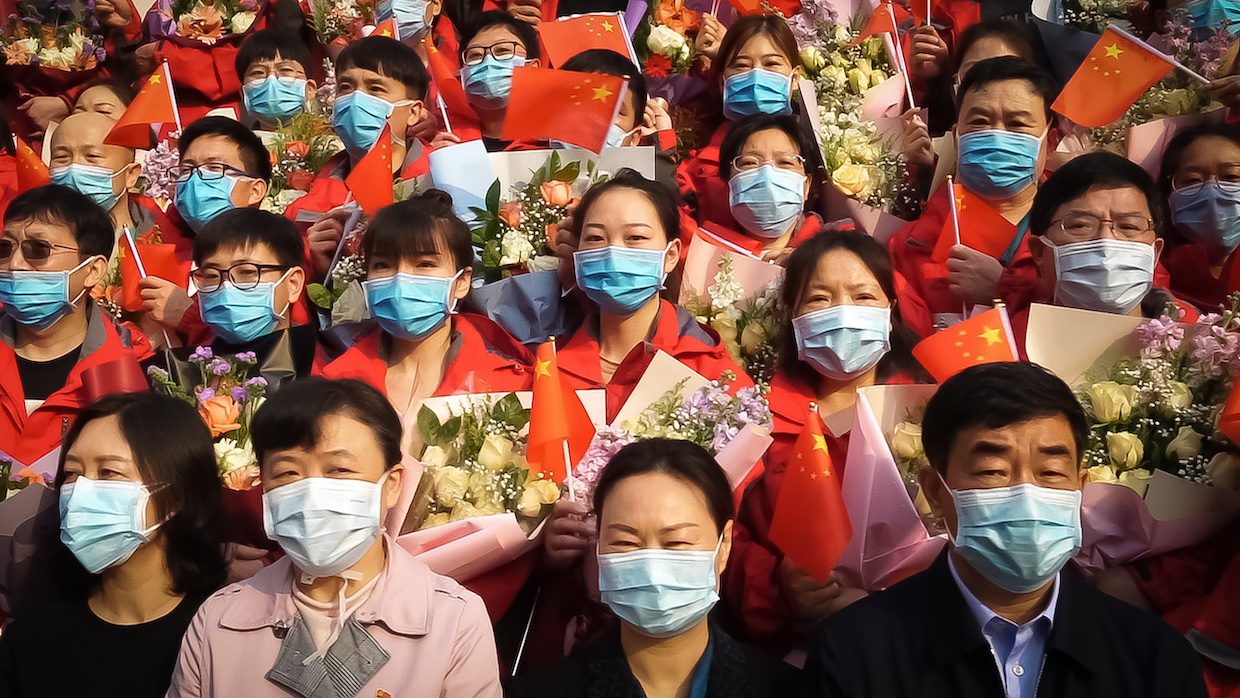 In The Same Breath
 Given the amount of turmoil, despair, anger, and loss we’ve experienced during the COVID-19 pandemic, it’s fair to say that the past two years have been the longest 20 years of our lives. As breaking news changed rapidly and information was uncovered, the severity of the virus came into focus. As dangerous as COVID-19 was (and, given the acceleration of mutated variants, how dangerous it continues to be), just as damaging was the misinformation being spread by various government-sanctioned media and harebrained conspiracy theorists.
Nanfu Wang’s latest documentary, In the Same Breath, covers the entire gamut and, per her signature style, incorporates the filmmaker’s POV as an entry point into this health crisis. Showing no signs of fear as she weaves her personal story into the grander, macro outlook of a pandemic that has killed close to five million people, Wang’s film questions her home country’s role in the outbreak and its attempts to silence potential whistleblowers. Having lived in the United States since 2011, Wang also examines the unique role America has played in the spreading of misinformation and the helplessness it has left its citizens feeling.
Having premiered earlier this year at the all-virtual edition of the Sundance Film Festival, In the Same Breath is now available to stream on HBO Max. A few days before the film’s broadcast premiere, I spoke with Wang about how quickly the project came together, working remotely with cinematographers across the world and how she knew when she had found the perfect ending.
Filmmaker: You lay out the origins of In the Same Breath in the film’s opening voiceover, but just to break it down further: as is your family’s tradition, you visited your family 200 miles east of Wuhan for New Year’s before eventually flying back home to the United States for a work trip. If memory serves, you were on the World Cinema Documentary Jury at the Sundance Film Festival that year.
Wang: I was. I arrived back in the United States for the festival’s opening night, January 23rd, 2020.
Filmmaker: What was that experience like, landing in Utah and immediately performing “jury duty” at Sundance while your son stayed in China with relatives? With the gravity of COVID-19 very slowly coming into focus, could you even wrap your mind around potentially making this the subject of your next film?
Wang: In some ways, the movie began at Sundance. For the first few days of the festival, I was trying to figure out what was going to happen to my family and if I should hop on a plane and fly back to China to pick up my son. At that time, I didn’t know if the situation [regarding the pandemic] was severe or if people were overreacting. Was the virus very contagious? Would it spread to where my mom lived? With the country shutting down, would I even be able to get my son back if I waited another two days to fly back? I was trying to come to a decision while I was attending Sundance. Luckily, as I grew more and more suspicious, my husband decided to fly back to China to pick up our son.
At that time, the only way I could obtain information related to the pandemic was reading developing news stories and scrolling through social media constantly. I was trying to reach out to people “on the ground,” to families with loved ones in the hospital, to people who worked for the government, etc. I was trying to find real information, as you don’t always get that from the news (and social media is, of course, filled with contradictions).
What was alarming to me was how quickly news would disappear off social media. I would find something, forward it to a friend or a family member, and two seconds later they’d respond with, “What did you send? We can’t see it.” As a Chinese person, the natural thought process is always, “Why would someone delete it if it’s not sensitive material?” It pushed me to collect a bunch of social media posts [related to the pandemic], primarily due to seeing in real time how quickly they were being deleted. My instinct then became to screenshot these social media posts and archive them instantaneously. As I spent Sundance scrolling through painful stories that weren’t getting picked up [by a larger audience], Jialing Zhang (my co-director on One Child Nation and a producer on In the Same Breath), who was also at Sundance and sharing a hotel room with me, stayed up all night, reading these painful accounts of the pandemic.
We quickly reached out to assistants who spoke Chinese and had worked on One Child Nation with us, asking if they could spend the next week, 24/7, monitoring online discussions related to the pandemic. We told them the websites to keep refreshing and that they should be archiving everything. This was an important task, as sometimes, if I didn’t check my phone for two hours due to being in a screening at Sundance, things would already be deleted off the internet. By the end of the festival, our team archived a number of shocking videos off social media. At the time, I thought about editing each of these videos together to show what Wuhan’s reality was, to show what we weren’t seeing in the news (and particularly what we weren’t seeing reported in Western media that doesn’t have similar access to China). I thought I was going to quickly make a short film and put it out, but by the time I left Sundance and returned to my home in New Jersey, I contacted several cinematographers to capture additional footage. The first footage they collected reminded me of what was happening in Wuhan’s hospitals. That’s when I realized that maybe this wasn’t going to be a short after all, and I began editing and filming some more.
Filmmaker: While In the Same Breath shares similar themes with One Child Nation, the latter film had the benefit of historical hindsight, while your latest is very much in the developing, chaotic now. Is it a different kind of experience making a film that’s reliant on rapidly developing news that’s being constantly recontextualized on a daily basis?
Wang: Not really, and I honestly didn’t feel that way! It was an interesting experience, to quickly realize that the parallel or continuation of themes I had explored in One Child Nation were surfacing again in my next film. One Child Nation allowed me to examine what propaganda was and the specifics of how it worked, how it changed people’s opinions on the one-child policy in China. Once I began work on In the Same Breath, I quickly observed the propaganda machine again turning out so many different types of media (whether it was news or various television series, etc.) centered around the COVID-19 pandemic. I realized that what was transpiring was the exact same strategy and method I had documented [in my previous film], except that this time I was witnessing it as it happened.
By May of 2020, I was honestly pretty depressed, as I knew the way that history (regarding COVID-19) would ultimately be rewritten in China, and I was also observing the parallel of how history was being rewritten in the United States. But whatever transpired after May 2020, it didn’t affect the way I saw this project, the way I viewed and identified its central themes. If anything, it confirmed what I believed when I started the project. The vision of the film formed gradually from January through early May of 2020.
I was initially planning to make a film that exposed the censorship/propaganda and lack of transparency and trust within China. But once March came around, I began to see what was occuring in the U.S. and was shocked to notice the same issues occurring here too.
Filmmaker: I imagine it was a gigantic scheduling endeavour to maintain “eyes and ears” on the ground in China and in various states across the U.S.. What was the experience like (as a filmmaker who had to, in some instances, direct remotely) crafting a film that wouldn’t necessarily allow you to be present at each location?
Wang: I can say that it was surprisingly efficient, and that I was pleasantly surprised by how free and liberating the process was. It was always going to be driven by necessity, as we knew that we couldn’t travel to China whenever we wanted to. It would be unsafe. But at the beginning of production, our plan wasn’t to necessarily reach out to ten camera people. It started with one person and grew out of necessity from there. We said, “OK, this person has access to a particular hospital, but we also want a team to monitor an ambulance, so let’s find another person to do that. But we also want someone to visit a potential subject’s home, and that will require a third person. We also want another person to visit a particular activist who is currently in a very sensitive situation, having experienced firsthand accounts of censorship and surveillance. I guess that will require hiring a fourth cameraperson…” That’s how our team gradually grew.
For the scenes shot in the United States, it was natural to grow our team given the progression of the virus in the country. The outbreak was occuring in different states at different times, so I reached out to cinematographers who lived in those areas. In terms of our communication, depending on whether the cinematographer was someone I had worked with before or a complete stranger, I still was familiar with their particular style. I wasn’t testing them out, for example. I was communicating directly by using visual references and detailed guides before every day’s shoot.
It was also extremely important to have their footage uploaded right away, every night of the shoot if possible. That way, I could review it quickly from home and, by the next morning, provide feedback and screenshot some of the footage to convey what I was or was not looking for (or ways they could film it differently). It was interesting getting to know the cinematographers I was working with for the first time, what their personalities were and where they were on the political spectrum. But you know what? What fascinates me is how you can tell all of those things just by looking at their footage—how they frame it in the moment, what they choose to focus on, what type of shots they use, whether they stay with a particular image or location. This was fascinating and extremely rewarding for me, getting to know the person better as a result of watching their footage. Once that became apparent, we adjusted and assigned assignments that would work best for that cameraperson’s particular style and personal views.
Filmmaker: In addition to featuring Registered Nurses (RNs) and whistleblowers as subjects, the film also documents the extremist views of the willfully misinformed. I’m referring to the types who shout that COVID-19 is all just one big “Plandemic” by the “Deep State,” etc. There’s a sequence in your film where you screen footage for RNs of these meanspirited rallies and it’s heartbreaking to watch. For me personally, when I read about some new conspiracy cooked up by the anti-mask crowd on social media, I tend to laugh, as it’s just so ridiculous. But your film is a bit more understanding of the way in which these folks are being fed misinformation. How did you arrive at the decision to feature them in this story and to show that footage to the nurses you spoke with?
Wang: Every decision was gradual and always a response to the material. The decision-making process involved in my including the U.S. in the film represented, for me, a personal quest of trying to find answers as to why America, a so-called democratic country that promotes freedom of speech, responded to the threat of the pandemic in their particular way that mirrored the same issues and problems facing China. When the [lockdown protests] erupted in the U.S in the spring of 2020, it was a point of interest for me, as it was perplexing and I wanted to do my best to understand. It was simply out of curiosity, and I wanted to know why the citizens thought the way they did and wanted to hear from them.
Our camera people visited each of these different states and came back with the respective footage you see in the film. Of course, we asked them to ask the protestors certain questions on camera. As I was reviewing the footage, the protestors’ answers were surprising, yes, but also anticipated. What was surprising to me was that if you didn’t have context for who these protestors were, some of their quotes in the film could be applied to anything for any [cause]. They said exactly the same things people who hold opposing political views would say, that they wanted transparency and accuracy and the truth. It begins to make you wonder: what does the truth look like to different people? Why does each one of us believe we are the owners or beholders of the truth? I’m sure a lot of people feel that way about themselves and their beliefs and that’s why there are so many different versions of what is considered the truth. It was simultaneously fascinating and sad for me to hear about these different ideologies, and how people hold what they believe are true beliefs due to shared ideologies. I feel that if we don’t understand those origins, then it will be impossible for two people of different views to have a dialogue. The dialogue thus far has consisted of people trying to convince the “other side” that only their beliefs are the truth, rather than listening to what the other person thinks. We could be more empathetic if we acknowledged that we all wanted the same thing and that, to some degree, we’re all similar.
Filmmaker: While the film had its world premiere at the Sundance Film Festival this past January, what was striking to me was that the final cut includes footage from Wuhan’s New Year’s celebration on January 1st….2021, serving as a chilling bookend to the previous 365 days covered in the film. Once the film was accepted into Sundance, did you continue editing up until your premiere?
Wang: We were picture-locked, or at least we thought we were picture-locked! But then I learned that they would be gathering together again in Wuhan to celebrate New Year’s, and I thought “Let’s film it.” I already knew exactly how I wanted it to be edited into the film and how it would be extremely important to the story and to myself. I knew we could do it quickly, and so I said, “Forget about being picture-locked,” we need to get that footage.
Filmmaker: Your films have kept me up-to-date with what’s happening in your life at the time of their filming, so congrats on the film and on your son, who has gotten much taller since your last film. Your films provide the viewer with an opportunity to check in and keep up.
Wang: [laughs] Well, I don’t know if my son is going to love me or hate me when he grows up and sees himself in my films!
Filmmaker: That too can be the subject of a film down the line!