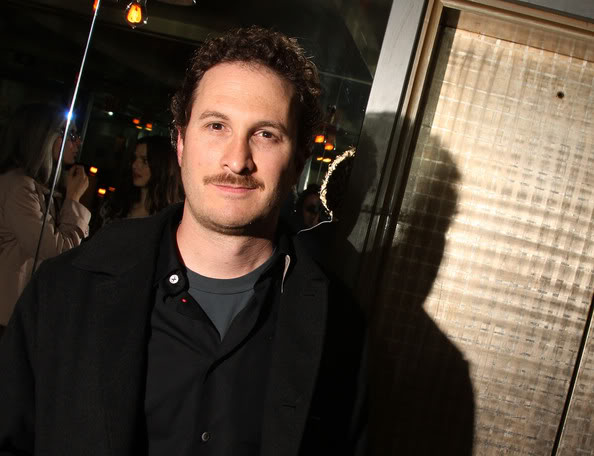
darren aronofsky
Friday, November 11th, 2011
Likely thanks to his work on the still-disturbing Requiem for a Dream, Darren Aronofsky was recently tapped to direct a series of anti-drug commercials for non-profit organization The Meth Project. The use of scare tactics in anti-drug campaigns is no new innovation (remember what happened to Rachel Leigh Cook’s brain?), but one has to wonder if the people responsible for commissioning these ads, which are set to air during an upcoming episode of Gossip Girl, would turn out quite so unsettling.
Watch all four ads below.
This one takes the cake for 30-second spot that you’d least expect to see airing on The CW:
The other three clips:
… Read the rest
Monday, March 7th, 2011
Ah, there’s nothing quite like the smell of pitches in the morning. This past Saturday, the IFP kicked off its annual Script to Screen Conference with five brave writers pitching their scripts to a panel of producers and agents.
Although all the panelists agreed that it was useful for writers to compare their projects to other films (a practice known as “using comps”) Peter Van Steemburg, the Director of Acquisitions at Magnolia Pictures, warned against using obvious ones such as “Juno or Napoleon Dynamite,” recommending that if you are pitching something that’s a lot like another movie, you should “immediately say how yours is different.”
Aida LiPera, Director of Acquisitions for Visit Films, encouraged one of the writers not to get lost in the details and to instead focus on “the major conflict” and “the high point” of his story. The panelists emphasized the importance of being specific when it came to both budget and casting ideas. Producer Peter Phok of Glass Eye Pix even recommended coming to a pitch with “visual material,” stating that he “loved it when pitches have art come with it.”
Next up was a case study of Borderline Films, the team behind the recent Sundance favorite, Martha Marcy May Marlene, directed by Sean Durkin and produced by Borderline’s Antonio Campos and Josh Mond (and exec produced by moderator Ted Hope). After meeting as undergraduates at NYU, the trio quickly realized they all shared a common goal: to use the program as a launch pad for a fully functioning production company. While still in the program, the trio were all set to produce their first feature, only to have funding fall through at the last minute, an experience Campos called, “a huge blow.”
The trio kept working, eventually producing Afterschool (directed by Campos), which premiered at Cannes. Hope praised the filmmakers’ “willingness to fail” and cited it as a major reason that trio was able to “move beyond the page.” Mond explained their all for one and one for all production model: when one of the trio is writing, the … Read the rest
1 Comment
Category News | Tags: after school, Aida LiPera, Amy Hobby, antonio campos, barry levinson, darren aronofsky, Darren Arronofksy, Erin Greenwell, Eugene Hernandez, Glass Eye Pix, IFP, Jonathan J. Johnson, josh mond, Magnolia Pictures, Mark Heyman, martha marcy may marlene, Peter Phok, Peter Van Steemburg, R. Paul Miller, Script to Screen, Sean Durkin, Ted Hope,
Saturday, February 26th, 2011
The Film Independent Spirit Awards just wrapped (see it on IFC tonight @ 10ET) and Darren Aronofsky‘s thriller Black Swan was the big winner taking home four awards, including Best Feature, Best Director for Aronofsky and Best Female Lead for Natalie Portman. Winter’s Bone won the supporting acting prizes with John Hawkes taking it for actor and Dale Dickey for actress while James Franco won Best Male Lead for 127 Hours, Banksy‘s Exit through the Gift Shop won Best Documentary and Lisa Cholodenko and Stuart Blumberg won Best Screenplay for The Kids Are All Right.
Also, “25 New Face” alum Lena Dunham won the Best First Screenplay prize for Tiny Furniture and Mike Ott, who we awarded with our “Best Film Not Playing at a Theater Near You” award at this year’s Gotham Awards for his latest Littlerock, won the Someone to Watch award.
Read the full list of winners below.
Best Feature
Black Swan
Best Director
Darren Aronofsky, Black Swan
Best Female Lead
Natalie Portman, Black Swan
Best Male Lead
James Franco, 127 Hours
Best Supporting Female
Dale Dickey, Winter’s Bone
Best Supporting Male
John Hawkes, Winter’s Bone
Best Screenplay
Lisa Cholodenko and Stuart Blumberg, The Kids Are All Right
Best First Feature
Get Low
John Cassavetes Award
Daddy Longlegs
Best First Screenplay
Lena Dunham, Tiny Furniture
Best Documentary
Exit Through The Gift Shop
Best Foreign Film
The King’s Speech
Best Cinematography
Matthew Libatique, Black Swan
Truer Than Fiction Award
Marwencol
Someone to Watch Award
Mike Ott, director of Littlerock
Producers Award
Anish Savjani, producer of Meek’s Cutoff
Robert Altman Award
Please Give — Nicole Holofcener (writer-director), Jeanne McCarthy (casting director) and actors Ann Gilbert, Rebecca Hall, Catherine Keener, Amanda Peet, Oliver Platt, Lois Smith and Sarah Steele… Read the rest
1 Comment
Category News | Tags: 127 Hours, Black Swan, Dale Dickey, darren aronofsky, Exit through the Gift Shop, Film Independent, FIND, James Franco, John Hawkes, Lena Dunham, Lisa Cholodenko, Littlerock, Mike Ott, natalie portman, Spirit Awards, Stuart Blumberg, The Kids are All Right, Tiny Furniture, Winter's Bone,
Friday, February 25th, 2011

This piece was originally printed in the Fall 2010 issue. Black Swan is nominated for Best Picture, Best Director (Darren Aronofsky), Best Actress (Natalie Portman), Best Cinematography (Matthew Libatique), Best Editing (Andrew Weisblum).
Darren Aronofsky was developing a project based on Russian novelist Fyodor Dostoyevsky’s 1846 novella, The Double, when he happened to go to a production of another Russian work, Swan Lake, the 1875 ballet composed by Peter Tchaikovsky. Seeing the ballet’s White Swan and Black Swan played by the same ballerina, Aronofsky experienced what he called a “Eureka” moment, realizing that The Double’s themes of splintering identity and possible schizophrenic breakdown could be found in the classic ballet.
Something else could be found there too — an early incarnation of the highly disciplined, sometimes punishing work ethic and training regimen that turns the most gifted students into beautiful ballerinas while clouding the futures of those with less talent. Swan Lake has been produced in many versions over the years, but the roots of most contemporary productions are the 1895 Russian production choreographed by Marius Petipa and Lev Ivanov. The Italian ballerina Pierina Legnani danced both lead roles, and she famously introduced the physically demanding 32 fouettés into the ballet’s “Black Swan Pas de Deux.” After Legnani, fouettés became a standard requirement of a ballerina, with the ability to do 32 a certification of her skill and endurance.
In Aronofsky’s darkly seductive, deliriously entertaining Black Swan, Natalie Portman plays Nina, a New York City Ballet ballerina whose life is still defined by the dreams a young girl has of dancing on the big stage. When she’s not rehearsing she lives with her clingy, slightly bitter and overprotective mother (Barbara Hershey) in a run-down Manhattan apartment building. In Thérèz DePrez’s production design, her bedroom is that of a child’s, its fairy-tale furnishings now more disturbing than playful. She has no romantic relationships and, indeed, as articulated by the company’s brilliant director, Thomas Leroy (Vincent Cassel), the question of her ability to perform the lead role in Swan Lake has more to do with unlocking her sexuality … Read the rest
Friday, February 11th, 2011
Over at The Browser, Black Swan director Darren Aronofsky names and discusses his top five books on films and filmmaking. There’s an obvious one (Sidney Lumet’s Making Movies), an unexpected autobiography (Kirk Douglas’s The Ragman’s Son), and then the following screenplay tome. From Aronofsky’s piece:
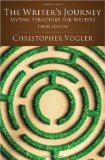
The Writer’s Journey, Christopher Vogler. It’s the Bible for screenwriters. I think it’s the best book on how to write a screenplay ever written. It helped me get through so many roadblocks as a writer.
Vogler adapted the work of Joseph Campbell, an American academic, to the art of screenwriting. Vogler’s approach to screenwriting was based on Campbell’s theory that, because of myths, the arc of a hero’s journey was a story ingrained deeply inside all of us. I really incorporated his ideas and techniques into how I structured films—I referred to it a lot.
By the time I became a working filmmaker, Vogler had become larger than life to me. When another filmmaker I know well—Scott Silver, who wrote The Fighter and is an old friend from film school—told me he had met with Vogler, I nearly had a heart attack. I thought: Whoa, you can actually talk to him! So I eventually got in touch myself. He gave me some feedback on some drafts. I got to hang out with him socially, and he’s become a friend.
I teach sometimes, and always say that The Writer’s Journey is the first book that everyone’s got to read.
Read the complete list at the link.… Read the rest
Monday, January 10th, 2011
Things didn’t bode well from the beginning. The crowd in the theater was restive. People shifted uncomfortably in their seats even before the movie began. I was alone, and sat in the back, the projector whirring somewhere above and behind me. But that was only the beginning. As it turns out, I had been editing Alla Gadassik’s remarkable video-essay for the Requiem // 102 project, and had learned of an obscure Italian Jennifer Connelly film from 1988, Etoile (directed by Peter Del Monte), which also happens to be a nightmarish film about Swan Lake that also features a monstrous black swan. Daronofsky + Connelly + Requiem + Black Swan. All these things swirling in my head, in the same way that each of us enters the dark of a movie theater with fragmented narratives in our heads, in hopes that the movie we are about to see will transport us outside of ourselves, into some other world.
And that’s the battle: between ourselves and the screen. We need big screens—forget scrawny computer or iPad or whatever screens—to take us out of ourselves. Black Swan on the big screen, not some puny screen six months from now.
In Robert Coover’s 1987 short story “The Phantom of the Movie Palace” the lonely projectionist, playing films to an empty theater night after night, takes matters into his own hands, becomes his own DJ mixer of visuals: “Sometimes, when one picture does not seem enough, he projects two, three, even several at a time, creating his own split-screen effects, montages, superimpositions. Or he uses multiple projectors to produce a flow of improbable dissolves, startling sequences of abrupt cuts and freeze frames like the stopping of a heart.” This was Coover’s pre-digital fevered dream, a mix-tape of styles and symbols, played out mashed-up on the big screen. In a similar vein, Black Swan jumps tracks between genres, shape-shifting in the same way that Nina shape-shifts.
And so: there was trouble in the theater. A weird vibe. Just before the film began, a group of hooded teenagers entered and sat in the front row. … Read the rest
Sunday, December 12th, 2010
Director Asa Mader and choreographer Benjamin Millepied, currently being celebrated for his choreography for Darren Aronofsky’s Black Swan, have collaborated on a short starring Millepied and French actress Lea Seydoux. (Update: Millepied is also being reported as Natalie Portman’s fiance and the father of her baby.) From Nowness:
After meeting at a dinner one night about five years ago, director Asa Mader and current principal of the New York City Ballet Benjamin Millepied struck up a friendship. “We immediately had a connection,” says Mader. The duo subsequently holed up over a long weekend in the Hamptons (they stayed at the former residence of veteran NYC ballet choreographer Jerome Robbins) to brainstorm a collaboration. The results of that session finally come to fruition today in the premiere of the directors’ edit of the evocative romantic short Time Doesn’t Stand Still, which will be released in its entirety in 2011. Featuring an original score by legendary David Lynch composer Angelo Badalamenti, the film’s classic, timeless aesthetic is enhanced by stylist Aleksandra Woroniecka, who plundered Ralph Lauren’s current collections as well as the house’s archives. “There’s a universal language that we were trying to explore,” explains Mader of the spare French dialogue and intimate choreographed gestures.
Released this week is the section below, a tango dance “that serves as the dramatic lynchpin of the film.”
… Read the rest
Friday, December 10th, 2010
(Editor’s Note: This essay contains spoilers.)
In literature or in oratory, where rhetoric arose from, it’s somewhat difficult to separate the argument’s mode of persuasion from its substance. In order to make an entirely skilled rhetorical point, the writer or speaker will have to present a series of assumptions and assertions, facts and hypotheses, in such a way that makes the argument’s substance apparent. That’s why literature lends itself to the intellectual: it’s founded upon a progression of ideas.
Cinema is often referred to as a different kind of linguistic medium (the “language of film”), but a linguistic one nevertheless, and it’s true that cinema has its own rhetorical tools. A film’s style — the sum total of its formal decisions — becomes a mode of rhetoric, as the film tries to advance any number of points. The points being advanced aren’t necessarily didactic in nature — it’s not like every, or even most, movies are trying to “tell us” something directly – but as a movie progresses, it builds an argument, a case, whether it wants to or not. The problem is that, while text or speech is (to a certain extent) predicated upon an argument that follows a logical progression, cinema can make its arguments in a less logical fashion.
I found myself thinking about all this after I saw Black Swan last Friday. The film is utterly compelling, stylistically superb, but it advances a few ideas about art that I realized, after the haze of the film’s compelling rhetoric faded, I entirely disagreed with. Yet that didn’t diminish my enjoyment at all; the film’s rhetoric/style and its ideology were two separate things for me, even though the film uses the former to advance the latter. This separation is hardly an uncommon thing — for an extreme example, think of Triumph of the Will, which is a stylistically superb film that advances an appalling ideology; ditto Birth of a Nation.
Still, the more I thought about Black Swan, the more it began to bug me: the movie was so much fun to watch, yet … Read the rest
5 Comments
Category Web Exclusives | Tags: alfred hitchcock, andrei tarkovsky, Black Swan, Blue Valentine, darren aronofsky, david lynch, Derek Cianfrance, documentary, Federico Fellini, Gaspar Noe, michael haneke, Michelangelo Antonioni, Requiem for a Dream, stanley kubrick,
Friday, November 26th, 2010
The Requiem 102 project, in which various critics, writers, and filmmakers (mine is here) dissect individual frames of Darren Aronofsky’s Requiem for a Dream, is now in its third week, and the quality of submissions is both amazing and diverse. The latest is photographer Bruce Livingstone, who has made a short narrative commenting on the film’s early love scene.
Reading the Love Scene in “Requiem for a Dream” from Bruce Livingston on Vimeo.
Another good one: novelist and short-story writer Elizabeth Hand’s “potent blast to the nervous system.” … Read the rest
Thursday, November 4th, 2010
This blog post is part of the Requiem 102 experiment: on the occasion of the 10th anniversary of Darren Aronofsky’s Requiem for a Dream, different writers are each looking at the film through the prism of specific frames, one from each minute of the film. I’ve been assigned minute four. Follow all the responses here.
For me, the most memorable scene in Darren Aronofsky’s Requiem for a Dream is not in the movie but in the script. I had read it before the film’s pre-production, and the scene in which dealers line up for a new shipment of drugs after the city’s dry spell took place not in the back of a supermarket but on the beach. A ship sat on the horizon, a small boat sped to shore, dealers set up a card table on the sand, and a line of addicts stretched for miles to get their fix.
A great scene — too great in scale for a $4.5 million independent film. I remember seeing Requiem for a Dream at its Cannes premiere, at midnight. I was sitting way up in that huge room at the Palais, where the seats are raked so steeply you feel like you’re going to succumb to vertigo and fall into the orchestra. I waited for that scene, was disappointed when it didn’t arrive, but had forgotten all about it by the time the film’s assaultive third act, with its accelerating editing rhythms, had finished.
With Requiem for a Dream Aronofsky created a ruthless symbolic universe bordered by the contours of the film’s formidable sense of style. But unlike many Hollywood films where style is an end to itself, here the production design, cinematography and even the glamour casting serve only to give the film’s ideas clarity. Hermetically sealed, Aronofsky’s film sidearms Hubert Selby, Jr.’s junkie tale away from the conventions of the genre, the grey, grainy streets filled with Ratso Rizzo clones, making clear that the story is not about drug addiction but the ways in which consumer capitalism mediates not only our daily lives but our ability to rationally conceive … Read the rest