Back to selection
The Trip: Gaspar Noe’s Enter the Void
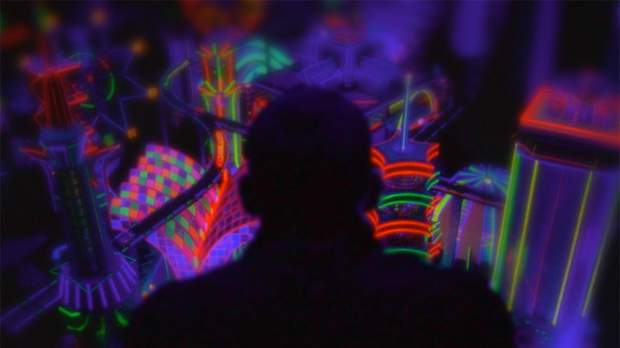
He stands alone.
Notoriously uncompromising in his aesthetic choices, distrustful of the broader film industry and unsparing in his subversion of audiences’ desires, Gaspar Noé is nearly 50 and yet he’ll always be an enfant terrible, the jewel of New French Extremity. Like any good auteur, Noé, the 46-year-old Argentinean born, New York- and Paris-raised technophile and slapstick philosopher, gets all of us citizens of Seriouscinemastan talking, but at a level of intensity few other internationally recognized film directors can. His newest film, Enter the Void, has already provoked arguments well into the night amongst the few cinephiles who have been privileged enough to glimpse its altogether unusual treasures.
The outlines of Noé’s gut-punch vision of cinema were found in his first major film, 1991’s 40-minute-long Carne, the tale of a Parisian horsemeat butcher avenging a rape on his autistic young daughter. A sequel followed, I Stand Alone (1998), an “anti-French movie” in which Noé’s butcher character, whose racist rants comprised much of the film’s first-person voiceover, represented the country’s dark underbelly. Both films were shot over long periods of time, but his next film, 2002’s Irreversible, a trippy and harrowing love story that unspools backward from a harrowing rape and its mistaken revenge to more innocent times, was made quickly in just a few months. From the days of Carne, though, Noé had in mind Enter the Void, and over the years he refined his vision and waited for both technology and his own rising auteur status to enable its production.
After bowing at Cannes 2009 in unfinished form to much prescreening trepidation (the film was not officially completed until just before its American premiere seven months later at Sundance), Enter the Void has inspired a critical debate that’s almost parodic in its divergent opinions. On this magazine’s website, filmmaker Michele Civetta called it a “philosophical tour-de-force disguised as a generational drug film,” while Variety’s Rob Nelson said Enter the Void is “Not clever enough to be truly pretentious.”
Gentlemen, take your marks…
Noé’s trippy vision details the final moments of life and then the brief, wondrous afterlife of a young European drug dealer (Nathaniel Brown) in Tokyo. Obsessed with his stripper sister (Paz de la Huerta) and killed in a police raid, Oscar finds his soul separating from his body and then hurtling over and into the strobing, neon-lit sex district of Tokyo, searching for both a resolution to a life cut short as well as a new resting place. Enter the Void harkens back to the work of filmmakers as disparate as Stanley Kubrick and Paul Sharits, Kenneth Anger and Peter Tscherkassky, as well as first-person shooter video games and hallucinogenic drugs. Yet, in the end it is about the depths of familial love and, in its seemingly endless visual inventiveness, unlike anything you have ever seen.
I spoke with Noé about his film, which IFC Films will open this summer theatrically and on VOD, in a small but expensive hotel room at the Park City Marriott after he had enjoyed a Budweiser beside the indoor pool, all the while watching his star, Paz de la Heurta, walk around in a black leather outfit that might have been pulled directly from The Matrix.
You’ve said that Lady in the Lake was a starting point for you. Yes, Lady in the Lake, smoking joints, eating mushrooms, reading books about life after death.
Like the The Tibetan Book of the Dead? Yes.
The opening 45-minute take reminded me of Kathryn Bigelow’s Strange Days. The first draft of the script was written before Strange Days came out. The opening scene in that film is amazing, but I had written an original version of Enter the Void where the movie started as a [first-person] POV. When Strange Days came out, I said, “Shit, someone did it before me.” But it looked so good on screen, so, I said, “Well, I was right, my POV’s going to work. I’m just going to add blinks because in her movie the main character doesn’t blink!” [laughs]
So you wrote it in the early ’90s, before I Stand Alone? Simultaneously. I Stand Alone was done over a period of four years. At that time I was also writing. Maybe after Carne I started writing, I’m not sure. For me, I Stand Alone was something that I was doing because it seemed to me that it would be easy to do a 40-minute extension to Carne and make a feature out of it. But the extension became a feature by itself, and it took me four years instead of one year. The first version [of Enter the Void] comes from that time. At one point I was even considering shooting the movie in New York because I wanted the movie to be in English. But finally, of course, I went to Tokyo. I had been doing some promotion for my movies in Tokyo, and I love the city, so I thought this was the best landscape I could have for the movie.
The visual landscape of the film is so married to Tokyo, it really doesn’t feel like it could have taken place anywhere else. In the first script, there were no details about where it was. It was just a big city. It could have been shot in Brazil, Hong Kong or somewhere else. I was raised from the age of three months to 5 in New York. For me, New York was my first perception of what a city was, so shooting in New York would have been normal. But it seems that the psychedelic drug scene has sort of disappeared there. What New York was in the ’70s it’s not anymore.
It’s in Bushwick now. Where?
Bushwick. Where’s that?
In Brooklyn. I see. I wanted to have big buildings and colorful neon lights and people losing their minds in that kind of environment; Tokyo was a better place to shoot.
Given the film’s intensive computer graphic work and technical demands, did you ever doubt that you’d be able to make it? It’s the most CGI-intensive specialty film I’ve ever seen. One day when I was moonlighting as a journalist, I interviewed Kenneth Anger. I asked him, “What do you believe in?” He said, “I believe in the power of will.” I said, “Do you believe in any kind of god?” “No, in the power of will.” But it’s true: if you’re very focused on something you desire — in this case it was this movie — you turn down all kind of proposals. I was proposed many of the French movies you’ve seen lately, big budgets, and I said no. I had in mind this movie for many years, and I didn’t want to get off the track. Even Irreversible was just, how do you say, a bank robbery that I made in order to do this one, to test some cranes, visual effects, and digital postproduction. For me, Irreversible was more like an experience than a real movie. Between the moment we had the idea for the movie and the moment we started shooting it was like five weeks and then we were finished shooting in six weeks. But yes, everything that I was doing for the last few years was in order to get this one done. As I said, it was hard to do. There were many different companies that said they were going to roduce the movie, but then passed. I would be in the middle of making deals and then they would turn it down at the end because it’s difficult to have a movie with explicit sex scenes, no famous actors, etc.
Who would end up supporting it? The most daring people that I know in film production nowadays are in France, the Wild Bunch team. They had sold Irreversible all over the world so they knew you can do a commercially successful transgressive movie. I don’t know what’s going to happen with this one, but that’s what happened with Irreversible. They decided they would produce the movie. There’s an arthouse production company called Fidélité Films that took care of the real production — none of the financing, but the production — along with Canal+ and BUF, which did the visual effects on Fight Club and 2046. They came on as co-producers of the movie too.
Did BUF get involved because they were so taken with the visual ideas that you presented to them? There are things in life that you do for the money, and there are things in life you do just because you want to do them, because you believe in them or you enjoy them. I guess for them it was very exciting to do this movie. Although it was risky, they decided that they would co-produce the movie, and of course the movie would never have looked the same without them. All the movie is based on visual effects, digital postproduction.
Are there any shots in the movie that don’t have visual effects in them? No, even in the flashbacks we had to recreate backdrops in postproduction. Everything in the image had to be retouched or recreated in computer graphics.
I feel like the film takes place in movements, in the musical sense, in that there are whole sections that are arranged around a single aesthetic conceit. There’s one movement that’s all about the point of view — the soul leaving the body and hovering above us. The next movement is largely filmed from that vantage point, those hovering shots… When he has the magic mirror of his past life! They say sometimes in books that at the point when you’re dying you reconsider your whole life. Suddenly you have all the most important images of your life put together in your head, and you come to a conclusion about whether your life was worth it or if it was just crap, or just another experience of the void. But, during that part, I tried to portray his memories as I perceive my own memories. When I think of my past, or even now when we are having this discussion, in one hour when I’m reconsidering this particular moment, I will put myself inside the frame. I don’t know why, but in memories I put myself inside the frame. I think most people do that.
These scenes resemble first-person shooter video games, where the point of view is behind the character’s head. Yes. There’s something a bit artificial and awkward about POV in most movies. If you do a POV in movies, it’s kind of funny in a way it’s not supposed to be; when you have the guy inside the frame, it seems like it’s more realistic in some ways, you know? In Elephant, by Gus Van Sant, there are a lot of shots with the guy from the back. Since the beginning I knew that I wanted to have all that part of the movie fully shot from the back of the neck of the guy. He could be on the right side, on the left side or in the center, but it was not linked to the video games. When I play video games, I much prefer killing dinosaurs or zombies. I love the ones with zombies attacking you. I like it much better when you just have the gun but you don’t see the character inside. It really works better for me; I get scared when getting attacked by dinosaurs. [laughs]
When do you know you’re ready to shoot a scene? I say that more about your preparation with the actors, bringing them into the appropriate emotional space, as opposed to the technical side of it. I’m a technician, above all. For me, directing actors is just finding the right people and putting them in the right mood on the set and letting them go. I’m a mood enhancer. You trust the people. I just say, “You can improvise, do your best, make yourself cry as you can.” I’m very hands-off. I really don’t like rehearsing in another location the day before or the week before. I think the energy has to come on the set at the very last minute. I usually know I’m ready once I have chosen the characters for the movie and once I have chosen the location. Once I go there, I put the actors on the set and ask them to do the scene as they consider doing it naturally. Once you know that she would sit on the sofa, and he would be sitting on the bed, you ask yourself, “Where could I put my camera here?” In the case of this movie, like for Irreversible, most scenes are master shots. If you’re not sure your decision is the right one then you can shoot another master shot from another point of view. Or you can move your camera to the right side of the room. For the crane scenes there were versions that were longer and other ones were shorter.
Are you married so much to the words in your screenplay? No, no.
So the preference for naturalism extends to that as well? For I Stand Alone, the actor read the script once. And then I took it off his hands and said, “I don’t want you to read the lines that I wrote. We’re going to find the proper words on the set.” I like playing with my script. This script was so long, 130 pages I think. I had a phobia of rereading my own script. It’s weird, because for the two years before we shot the movie, I maybe read it once through. [I read it] technically scene by scene, but not in a row. I had problems getting back to my screenplay. I was always saying that one day I have to read the whole script in a row before I start shooting to see if I want to modify something. But we were just at a point where you can’t deal with the words anymore —you want to see images. So I was excited about doing location scouting or watching experimental movies as references or things like that. Everyone was saying, “You have to read the whole script again,” and I would say, “Yeah, yeah, I’ll do it this weekend,” and it never happened. And my assistant director, he’s very, very professional, he was always saying to me, “In scene 155a the two policeman and the Indian…”
And you would have no idea what he was talking about? None! He had in mind the numbers of all the scenes. He’d say to me, “Give me the [scene] number,” but for me it was like he was talking about some other project. I didn’t know what he was going on about.
I ask that about the language mainly because one of the things that always sticks out to me about your films — more in I Stand Alone, Carne, and this film than Irreversible — is your use of voiceover as an insistent, uncompromising presence. In this film what I find so interesting is that we only get that interior voiceover up until Oscar dies. Then, his voice goes away but his presence is still very much there. I mean the frame, we can assume, is set at times from the point of view of the soul, but at that point he has no voice. He’s no longer a participant. Actually, when it comes to the resurrection, in the script there was much more voiceover.
Especially during the first part, when he’s getting high, there was a relentless voiceover. If I didn’t manage to edit it properly it would have taken too much time. Maybe one day when it comes out on DVD I will do an alternate version with a lot of voiceover at the beginning, an alternate mix. In I Stand Alone the voiceover worked very well. But it’s very artificial because he’s talking in a very linear way. It’s not very mental.
In this film, when Oscar is dying his thoughts are so disassociated, as I can imagine they would be when your life is seeping away. I would say thoughts are always a bit disassociated. In your own brain you never finish your sentences. You just stop. I like words because words bring forth images. When Oscar begins to die until the end of the movie, the movie is not very talkative. But I would say for the first part of the movie, he talks too much. In dreams you don’t have many words; from time to time someone tells you something but words are just information that has to be told. The words are science. In [real] dreams people don’t talk per se; it’s like everybody’s a telepath. The guy has his mouth closed but you know what he told you. If you want to portray a proper dream people wouldn’t open their mouths but the words would come out. In Mulholland Drive, a very dreamlike film, for example, it’s very talkative. But toward the end as the illusion of Hollywood success is pierced, people stop talking. It’s closer to a real dream because you can perceive it while you’re sleeping. Have you ever seen an experimental movie called Outer Space by Peter Tscherkassky?
No. At one point there was a reference that I wanted to copy, but it was too much. If you see that short film, it’s actually made with footage from The Entity, the movie with Barbara Hershey. When you see that movie it really makes you think of your own dreams, or the language of your brain when you’re sleeping.
I kept thinking of two experimental films while watching your film. They probably had no bearing, but one was the work of Bruce Conner. He would make these found footage films, my favorite of which is called Report, which is about the Kennedy assassination. It uses the flicker effect that you use to great effect in this movie. The other was a Paul Sharits film. T,O,U,C,H,I,N,G.
Yes. In the last hour of the film I kept thinking of that film because of the explosive use of psychedelic colors. There is a color flicker at the end in the love hotel scenes. One frame out of six is all blue, one frame out of six is all red and out of focus, so you have a weird color flicker. I would say I had more in mind, maybe Anger’s Inauguration of the Pleasure Dome or some of Brian de Palma’s movies. I really like aerial shots and everything in the one with Nicholas Cage. Snake Eyes I think.
That’s right. Snake Eyes also has a bravura long tracking scene. A good one.
What were you looking for when you cast your actors? Ironically, because of the first-person perspective, your lead character is offscreen much of the movie. I had two major concerns: one is that the brother would look like the sister. I met Paz [de la Huerta] before I met Nathaniel [Brown], about a year before I started shooting. I met Paz and I really liked her. She had the profile for the character because she likes screaming, crying, showing herself naked — all the qualities for it.
I don’t think I’ve seen her in a film where she’s not naked. She’s very exhibitionist. She enjoys it — maybe that’s how she takes control of a situation, by intimidating people with her body. But I had problems finding the right brother for her, so I didn’t promise her that she would be in the movie until I found a brother that could fit with her.
They don’t look terribly alike, though. No, but it makes sense in a way. When you see The Funeral with Vincent Gallo, Chris Penn, and Christopher Walken, you cannot believe that they’re brothers. I always care that there is some kind of similarity between them — they [both] have long faces and big ears. You can believe that they’re brother and sisters. That was one concern. Another concern was that the lead guy’s face would barely be shown in the movie, perhaps as little as two or three times, so I knew I didn’t want a “real actor.” They’re often very narcissistic in the way that if they’re in a movie they want to show their face. From the beginning I wanted someone who wants to become the film director for this movie, a film student. I was searching among the film students because the guy would learn how to make a movie on the set. When I met Nathan, I really liked the guy. He’s very intelligent and also he said he wanted to become a music video director. I said, “Okay, I’ll introduce you to Paz,” and then I saw that they would match. I met him about 10 days before we started shooting. In three days we called him and said you got the part, come to Tokyo and we’ll start shooting in one week. It was weird because he was selling t-shirts in Brooklyn. He had never been in a movie. He had just been photographed once for a fashion shoot. He told his boss, “Well, I’m leaving to be in a movie in Tokyo, so I have to quit.” Nobody believed him. From one day to the next, things happen so quickly for some of us. Next thing you know, you’re on the other side of the world.
What about the other actor who plays Alex, the friend? He’s not an actor at all. He was a bartender who had lost his job. He came to the casting with a friend. He didn’t want to [be in the movie]. He said, “I just wanted to tell you how much I loved I Stand Alone…” When I started shooting I noticed that he was not shy and that he could perfectly fit the character. The next day we called him and said, “You got the part.” He was desperate for money so he goes, “Great, I’m finally going to have some money.” It’s weird, that guy drinks a lot but he’s got the best memory. He was extremely talented as an actor.
So maybe it was the beginning of a career for him. The problem when you pick up people who are not meant to become actors is that suddenly they’re in this Cinderella movie. And then when the shooting is over, they come back to real life. So it’s a great experience, but sometimes it’s kind of painful the day the shooting stops.
This is the first film of yours where I feel there is a fulfilled, seemingly whole, loving relationship between two people — the brother and the sister. Even though they are troubled people, it’s a relationship of mutual love. What brought that on? It’s weird because some people who have a vision of what humanity should be tell me, “How could you make a movie with such losers as main characters?” But they’re just kids! I have been like them! Maybe I’m still a bit adolescent in some ways. This is a guy who’s only obsessed with fucking girls. Maybe he turns into a drug dealer because he meets girls and makes easy money, which allows him to become a d.j. When it comes to Paz’s character, she could be modeling or stripping or whatever brings her more money. At a point I thought maybe it would be stronger if the part was between a man and a woman who love each other rather than boy and girl [siblings] but then you could not have that traumatic experience at the beginning that they could share. If they met later they could not see their parents dying. I thought it was stronger if they were sealed by a blood pact that came out of an extremely traumatic experience. At the beginning that’s why I said they would be brother and sister, but still you feel like they behave like a platonic couple, even though there’s no incest. There’s more love than usual between a brother and sister.
Did you have to, because of how effects-oriented the movie is, design the movie more elaborately in advance than you normally would? Say you wanted to change a sequence after you arrived in a location; were you hemmed in because of the design and scale of the movie? Actually when I was in Tokyo shooting the movie, I was dreaming almost every night. My nightmare would be about where I put the crane and the space [being] too small. Even inside a studio after you build the set the cranes are so big that sometimes you cannot move the arm of the crane. My dreams would be about not being able to move the crane. The shots were prepared in advance, so if you make the wrong decision you have to pay for it. There are a few scenes that we would manage to make the camera escape the tyranny of the sets with computer graphics.
Some of your previous films, I Stand Alone especially, were shot in a piecemeal manner, over the course of a long time. Does that change your relationship to the material at all, working over such a long period of time? When you start editing the movie and you have a first edit of the movie and you know what’s missing, you can go back. We shot in Tokyo for a few months. We came back months later to shoot some additional takes for a few days, and then I went to Montreal to shoot the shuttle scenes. We put all the pieces together and then I had the first rough cut of the movie. I noticed that some other scenes were missing so we went back to Tokyo to shoot three more days. We shot the cremation scene and also the shot of the camera coming out from the tunnel. It looks like a scale model but it started with the crane on the streets of Tokyo. Some helicopter scenes were missing too. In the case of this movie because it was very long and exhausting, at a point you’re not happy to go again to Japan because physically you’re exhausted, and so it’s bad if the movie needs it. It’s like a baby — if a baby needs food you have to give him food. So if the movie is dysfunctional you know what you need to do to make it functional. You have to go back to Tokyo to shoot those scenes.
Do you have something in mind for your next project? There’s an erotic film project that I was proposed to do in 3-D. I would like to do a documentary too, but I don’t have a particular idea in mind yet. To start doing a documentary, like Tony Kaye did in Lake of Fire over a period of 17 years — get a subject, and work on it over a long period of time. Nowadays I’m watching much more documentaries than fiction movies. When I go to buy DVDs I always come back with eight documentaries and two fiction movies. Weird.