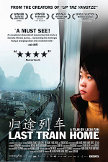
last train home

OSCAR DOC FEATURE SHORTLIST: WHICH TITLES SHOULD HAVE MADE THE CUT?

By

Thursday, November 18th, 2010

The Academy of Motion Picture Arts and Sciences revealed today the 15 films that have made their shortlist for the Best Feature Documentary category in the 83rd Academy Awards.

They include:

Client 9: The Rise and Fall of Eliot Spitzer, Alex Gibney, director (ES Productions LLC)

Enemies of the People, Rob Lemkin and Thet Sambath, directors (Old Street Films)

Exit through the Gift Shop, Banksy, director (Paranoid Pictures)

Gasland, Josh Fox, director (Gasland Productions, LLC)

Genius Within: The Inner Life of Glenn Gould, Michele Hozer and Peter Raymont, directors (White Pine Pictures)

Inside Job, Charles Ferguson, director (Representational Pictures)

The Lottery, Madeleine Sackler, director (Great Curve Films)

Precious Life, Shlomi Eldar, director (Origami Productions)

Quest for Honor, Mary Ann Smothers Bruni, director (Smothers Bruni Productions)

Restrepo, Tim Hetherington and Sebastian Junger, directors (Outpost Films)

This Way of Life, Thomas Burstyn, director (Cloud South Films)

The Tillman Story, Amir Bar-Lev, director (Passion Pictures/Axis Films)

Waiting for “Superman”, Davis Guggenheim, director (Electric Kinney Films)

Waste Land, Lucy Walker, director (Almega Projects)

William Kunstler: Disturbing the Universe, Emily Kunstler and Sarah Kunstler, directors (Disturbing the Universe LLC)

Though many deserving titles will be moving forward with the chance to be called when the Academy names its nominees the morning of Jan. 25, the doc shortlist announcement has in recent years become a time to focus on which docs were left out.

Glaring omissions: The Oath, Last Train Home, Joan Rivers: A Piece of Work, to name a few.

Soon after the announcement many took to Twitter to show their displeasure, including Zeitgeist Films which tweeted about doing a write-in campaign for their snubbed films, The Oath and Last Train Home.

Whether it be the Academy’s out-of-touch voters, or its confusing requirements to be considered, this time of year always causes many doc lovers (and filmmakers) to scratch their heads. But if anything positive can come from this, hopefully the attention to the titles that didn’t make it leads to more ticket/DVD/VOD sales for them.… Read the rest

LIXIN FAN, “LAST TRAIN HOME”

By

Wednesday, September 1st, 2010

Not many first-time independent filmmakers land a coveted spot in the Sunday arts section of The New York Times and an interview on The Leonard Lopate Show. But 33-year-old Lixin Fan, a Chinese-born Canadian immigrant who splits his time between Montreal and Beijing, has generated a lot of interest among editors at major dailies and business publications alike for his documentary Last Train Home, a film about the annual New Year’s pilgrimage of 130 million migrant workers from Guangzhou province to their homes and seldom-seen families in the rural provinces. China’s status as an economic powerhouse regularly makes front-page news, along with stories about the country’s ongoing struggles to manage crises that seem to grow directly out of frustrations among its most disenfranchised. Recent docs have explored the heady, often devastating changes wrought in China by warp-speed industrialization and the construction of the Three Gorges Dam (the largest civil-engineering project in world history), including Jennifer Baichwal’s Manufactured Landscapes and Yung Chang’s acclaimed Up the Yangtze, which Fan helped produce. But Last Train Home, which won Best Feature Documentary at IDFA 2009 and has screened at numerous festivals including Sundance, New Directors/New Films, and the Los Angeles Asian Pacific Film Festival, is a more intimate look at the new era of outsize industry.

For this engrossing, beautifully shot film, Fan spent three years trailing Zhang Changhua and his wife, Cheng Suqin, migrants who’ve toiled for over a decade in factories on the southeastern coast, leaving their two children in the care of their grandmother. Their lives are defined by grueling 14-hour work routines and the drive to save the pittance they earn manufacturing products for export to the U.S.  The decision to ride the train home for the New Year brings a different kind of misery, as the couple find themselves stranded at the station with tens of thousands of people, all fighting for a chance to climb aboard coaches that may never arrive. Back home, the Zhangs’ sullen teenage daughter Qin, resentful of her parents’ long absence and eager to earn money instead of completing her education, turns their … Read the rest

“LAST TRAIN HOME” | director, Lixin Fan

Saturday, January 23rd, 2010

[PREMIERE SCREENING: Saturday, Jan. 23, 12:00 pm -- Screening Room, Sundance Resort]

The most difficult decision I had in the making of Last Train Home is one that spans from shooting ground to editing room. It was at the painful moment when the crew and I witnessed the father become frustrated and hit his daughter right after they arrived at their village home before New Year’s Eve. To film or not to film? The ultimate question in documentary filmmaking was being put in front of me. In a filmmaking sense, this was a rarely intense moment, which revealed incredible personalities and conflicts of the protagonists. It also made an unusual twist to the story line, and potentially the climax of the entire film. But on a moral and ethical level, the filmmaker is, as always, being challenged if he should keep a documentary filmmaker’s observational objectivity or if he should be a compassionate human being. It’s a tough choice for any filmmaker.

When the father hit the daughter, I was in another room, and my cameraman and sound man were filming the outbreak of the confrontation. I heard the shouting and immediately came to the room. The daughter had already fallen on the ground. For a split moment, I had struggled to comprehend the situation and tried hard to make the “right” decision. I surely didn’t want to lose the scene, but it’s also difficult for me to see the family breakdown. We had spent so much time together, the crew and the Zhangs were like one family. I had been put on a hotspot at that moment when seconds felt like years. When again the daughter agitated the father and he tried to smash her the second time, my intuition took over mental debate, and I went into the frame to separate the two.

In the editing room, I had a very hard time and felt a serious moral challenge again over my own conscience. The Chinese culture always puts family in key positions in any interpersonal relationships. I felt I betrayed the Zhangs and myself as a human … Read the rest

VOD CALENDAR

Filmmaker's curated calendar of the latest video on demand titles.
Contagion The Guard Hell And Back Again
See the VOD Calendar →
Filmmaker's Best Of 2011

Entries (RSS) and Comments (RSS)

The Filmmaker Magazine Blog is powered by WordPress.org.