Back to selection
Los Angeles: The Movie-Watching Capital of the World
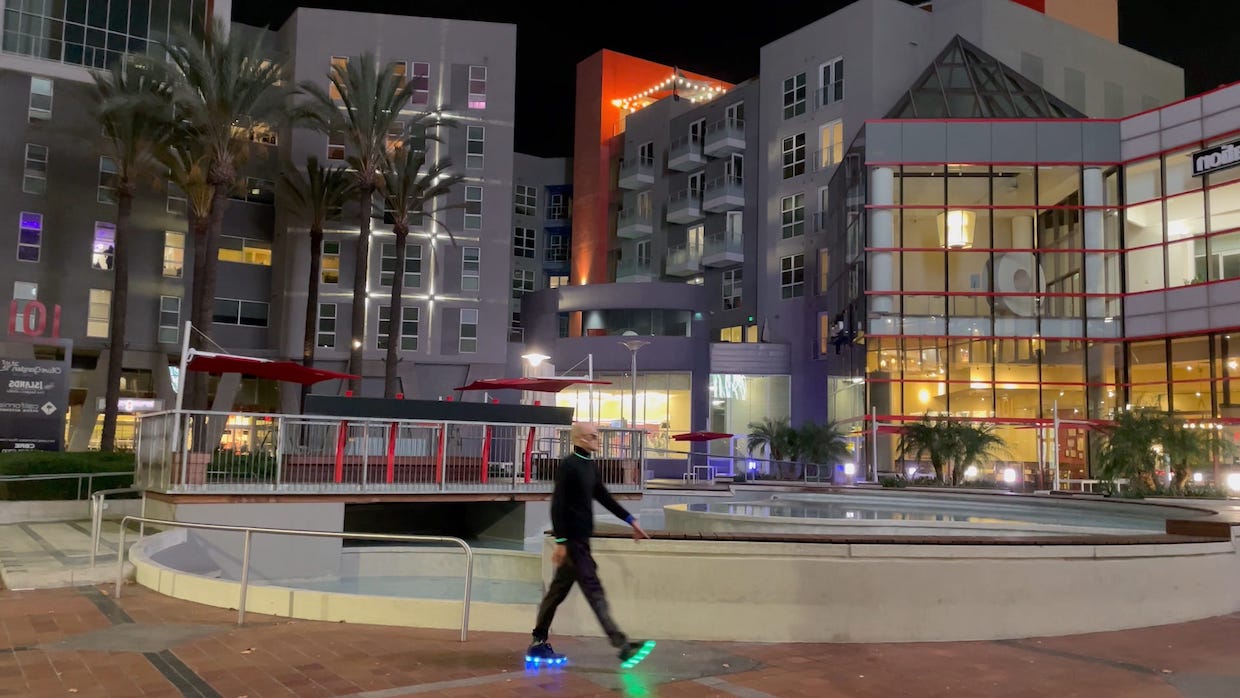 In the Glow of Darkness
 Moviegoing in Los Angeles has never been better, at least not in the 13 years I’ve lived in the city. When covering Slamdance’s move from Park City to LA last year, I listed a host of these either new or newly expanded theatrical offerings. In the year since, American Cinematheque, the undisputed king of repertory cinema in the city (at least in terms of scale), has acquired the historic Village theater in Westwood, with plans to re-open it next year. And Kristen Stewart’s recent purchase of the Highland Theatre is particularly exciting, especially considering that it’s located only one mile from where I live.
So while production continues to leave LA at an alarming rate, the question becomes: is Los Angeles transitioning from a moviemaking capital into a movie-watching capital? With a program largely made up of films either shot in LA or made elsewhere by LA locals and natives, the third annual Los Angeles Festival of Movies (LAFM) suggests that the city still attracts a strong independent filmmaking community.
Held each spring at venues spread across the Eastside of Los Angeles, many LAFM attendees come to the festival through co-founder Micah Gottlieb’s year-round Mezzanine series. Fellow co-founder Sarah Winshall brings her producing expertise (By Design, Strawberry Mansion) to ensure a smooth operation that typically eludes newer film festivals. The pair envision their audience as adventurous cinephiles, and they told Filmmaker they have been surprised to learn how greatly this core demographic overlaps with the city’s independent filmmaking scene.
This year, LAFM increased accessibility through a partnership with Cinecamp, which provided free childcare for festivalgoers during screenings. A new vendor market spotlighted local partners with a similar ethos to LAFM, including Eastside video rental store Vidéothèque, bookstore/café Stories, and The Big One, a Los Angeles literary magazine. Movie-wise, LAFM keeps the slate manageable with 11 features, two artist talks, and three shorts blocks. In that latter category, Sean Buckelew returns as a guest curator for Animation Today, a shorts block that has quickly become a highlight of the festival. This year’s selections included arguably the highest-profile title of the festival in Don Hertzfeldt’s Paper Trail, which won awards at both Sundance and SXSW prior to its LA premiere.
LA’s aforementioned indie film scene turned out in full force for the sold-out screening of In the Glow of Darkness, when writer-director-star Tucker Bennett invited everyone from the crowd who worked on the film up to the front and a long line of collaborators stretched across the stage. Many standing up front were LA filmmakers themselves, who often work together on each other’s shoots. Bennett co-edited Q&A moderator Eugene Kotlyarenko’s The Code, for instance, and is currently working with co-editor Sabrina Greco (Lockjaw) on Kotlyarenko’s follow-up, which shot in Japan last year. In the Glow of Darkness cinematographer Neal Wynne recently wrapped production on his sophomore directorial effort, which was shot in and around Los Angeles. Devon Daniel Green—whose lo-fi Mid/Evil Times has been touring around North America—appears in ITGOD as a bartender. I even performed some minor B-cam operation on one day of the shoot, but didn’t feel this contribution warranted stepping up onstage alongside everyone else. Bennett and co-writer/composer/producer Chris Corrente studied together under George Kuchar at San Francisco Art Institute, and their film’s setting—the dystopic cyberpunk Los Angeles stand-in San Zokyo—was only made possible by embracing their former teacher’s collaborative ethos.
Creston Brown was present onstage for that Q&A for his role in the film as an Apple Store–esque salesman peddling a drug-trip experience induced by scanning a QR code tattooed to one’s lower back. As a tastemaker, he was also enlisted by the festival to curate a selection of shorts made by LA filmmakers. Within that block of six films, Joey Izzo’s Sundance-premiering documentary Going Sane features a host of local actors and directors, including Lindsey Normington (Sean Baker’s Anora), Clay Tatum (who codirected The Civil Dead with Whitmer Thomas), and Kate Adams (Kristoffer Borgli’s Former Cult Member Hears Music for the First Time). These actors lip-sync dialogue from archival audio recordings of unseen individuals discussing their experiences as part of a therapy collective in LA, whose increasingly cultlike leadership spurred an internal coup. With Going Sane and documentary short You’ve Never Been Completely Honest, Izzo has carved out a niche as a chronicler of the bizarre cults that permeated 20th century America.
Christine Haroutounian’s After Dreaming wowed audiences with its poetic look at a girl being transported across rural Armenia by a soldier. Haroutounian told Q&A moderator Courtney Stephens (Invention) after the screening that the seed for the narrative was planted after hearing that a familial death was hidden from her grandmother by her family. Its deliberate pacing recalled Carlos Reygadas (an EP on the project), while Haroutounian’s staging of bodies as sculpture evoked the work of Claire Denis. And haunting rural architecture reminded me of the menacing barn in Philippe Grandrieux’s Sombre. As self-assured a debut as they come, After Dreaming is much more than the sum of these reference points. Josephine Decker—who had a new short in Brown’s Los Angeles–focused block and participated in an artist talk—effusively sang the film’s praises throughout the festival.
Frédéric Da used to teach film to high schoolers at a private school in Santa Monica, and after cultivating an eager batch of teenage cinephiles, he began making movies with them. Their first feature-length effort, Teenage Emotions, is composed of extreme close-ups shot by multiple iPhone cameras “like an Abdellatif Kechiche film,” he told me last year. His follow-up, Isaiah’s Phone, was also shot on iPhones, but deploys a diegetic framing device in which the audience watches a camera roll of a lonely student who records his daily life. In the post-screening Q&As, one of which I moderated, Da illuminated a unique creative process, in which he largely directed lead actor Isaiah Brody remotely, reviewing clips the teen shot via Dropbox before FaceTiming Brody with notes on calibrating his performance and adjusting the cinematography.
The lone world premiere in the feature category was Avalon Fast and Jillian Frank’s Drinking and Driving. The pair grew up together outside Vancouver, and while their lo-fi feature was aptly compared to Larry Clark in the program notes, it is also reminiscent of Harmony Korine’s early renderings of white-trash America, shifting that perspective to western Canada. With its vision of partying in no-man’s-land soundtracked by SoundCloud rap, it brought to mind Isabel Bethencourt and Parker Hill’s documentary Cusp, as well as Seventeen in its feel for how a party morphs as it moves deeper and deeper into the night. While both of these comparisons are documentaries, Fast and Frank’s feature is arguably more impressive for being a work of fiction, offering a raw, honest depiction of how self-destructive behavior can be driven by little more than boredom and lack of economic opportunity.
Sophy Romvari’s Blue Heron closed out the festival at Vidiots in Eagle Rock. Romvari’s feature debut continues her short films’ interrogation of complicated childhood memories of her troubled teenage brother. Her clarity of vision in rendering that period of her life is impressive, but an insistence on a supreme level of control over every element, from camera movement to color grade, leads to a film that, while undeniably personal, never approaches vulnerability. I’m reminded of research I conducted while writing a piece for this publication on film prints, where I learned that prior to digital post-production, filmmakers would color-time their films scene by scene rather than shot by shot. The process was imperfect, but instead of registering as a limitation, it produced a vitality within the frame. In Blue Heron, every image is exacting and deliberate. Following Romvari’s earlier explorations of her youth in a series of accomplished shorts, Blue Heron’s narrative and visual motifs feel workshopped, calculated, and ultimately airless.
A few nights after the festival, I attended an Erupcja screening, where Pete Ohs’s process—finding character and narrative in collaboration with actors on location—embraces precisely the kind of contingency that older workflows imposed by necessity. The method has clear limitations, but that spark of life, that spontaneity onscreen that I found myself longing for in Blue Heron, is present in Ohs’s new feature in spades.
To Gottlieb and Winshall, a critical component that differentiates a film festival from a screening series is having patrons come in from out of town for the festival. LAFM has grown each year in that department, with a host of filmmakers, programmers and distributors who now make a point to travel to the city each spring for the fest. I spotted New/Next founder Eric Allen Hatch and Factory 25 head Matt Grady, to name a couple. This element expanded the celebratory nature of this year’s particularly LA-centric slate, ushering it beyond a place for friends to cheer on their friends’ work. So while this year’s programming might’ve lacked the profile of previous selections I Saw the TV Glow or Friendship, it’s more important that LAFM seemed to take a step forward in pinpointing what type of festival it strives to be, with an increased focus on local filmmakers and on programming films that alternate between more traditional arthouse fare and active attempts to reframe the form.