Martin Scorsese

SCORSESE’S “HUGO,” MASHED AND REMIXED

By

Tuesday, January 17th, 2012

This video, apparently shot by an audience member watching Martin Scorsese’s Hugo at the Regal Union Square 14, is simply jaw dropping. For the last 20 minutes of the film, technological gremlins and an absent projectionist conspired to give the movie magic of Scorsese and Melies a 21st century twist. And this is after the film broke twice, making the entire run time three-and-a-half hours. Indeed, this is a viewing experience you won’t get at home. (For more, Gothamist has the story.)

Read the rest

2011 IN FILM: A DISASTER ODYSSEY

By

Tuesday, December 20th, 2011

For many supposedly serious cinema folk, there is no secret pleasure more pleasurable than the disaster film. What makes the genre so familiar – predictable plotlines, one-dimensional characters and an ever-present threat that only kills the people who deserve it – is also what makes it so damn fun. In the late ’90s, people cheered when the alien spaceship blew up American monuments. A full decade after September 11th, it’s still hard to imagine that happening now. During the past decade, disaster films have become more serious, less The Towering Inferno and more District 9, but it is only in the past year that the genre started to evolve into something entirely unexpected. In 2011, disaster was back, but this time? It was seriously good.

During several interviews about Contagion, his globe-trotting, virus-chasing thriller  (pictured above), Stephen Soderbergh openly referred to it as his take on Irwin Allen,  the master of disaster behind The Poseidon Adventure and The Towering Inferno, but unlike Allen, Soderbergh refuses to privilege one character over another, giving the same amount of screen time to the hero who saves the day as he does to a girl who just wants to go to the prom. A macro look at the micro response of human beings to a global crisis, Contagion is a relentlessly paced movie that feels as ruthless as the amoral virus at its center.

The derivative that threatens to take out the firm at the heart of Margin Call may be as ruthless as the virus in Contagion, but unlike that virus, it is not some fluke of nature. It is a threat designed by the very men now in charge of dealing with it. Set over the course of one very,very long night, Chandor’s debut never resorts to reactionary, easy criticism of the firm’s employees. He knows that at the heart of any failed system there is not just culpability but also humanity – that it’s not villains who create these problems but human beings. The result is a film that is as serious as it is entertaining, and far and away the smartest … Read the rest

SEE VIDEO FROM CANON’S NEW EOS C300

By

Thursday, November 3rd, 2011

At a press event in Los Angeles tonight, Canon announced two new digital cinema cameras aimed at filmmakers, the EOS C300 and the C300 PL (the latter differing by way of a PL mount). Canon CEO Fujio Mitarai said that the company wanted to “leave no story untold” as he unveiled a camera with a small form factor, an 8.3MP 2160 x 3840 Super 35 CMOS sensor with 4K resolution, and new lenses that resolve to this higher resolution. Martin Scorsese was on hand at the event to hail digital cinema and extoll the promise of the cameras. This promise includes accurate color reproduction and superior performance in low and natural light.

Vincent Laforet was also at the event, screening a short film, Mobius, shot with the camera. From Engadget:

A New York Times photojournalist turned Hollywood director, Vincent Laforet has become synonymous with DSLR video, after his short film Reverie helped catapult Canon’s 5D Mark II into the world of digital filmmaking. And after playing such a significant role in launching that camera, we certainly weren’t surprised to see Laforet make an appearance at today’s Canon Cinema event, with his short film Mobius getting some time on the big screen. The film follows a photojournalist who stumbles upon a Cartel execution, but it also tells the story of Canon’s tightly-veiled C300 cinema camera, which the company launched just moments ago. Laforet used a pre-production C300 (note the green tape button labels) to shoot Mobius in the Mojave Desert under a variety of harsh conditions, including powerful sunlight and near-darkness, in both extremely hot and chilly temperatures — the camera appears to have performed extremely well, given both the remote shooting environment and tight production schedule.

And that short film is here:

Mobius – 1080p HQ from Vincent Laforet on Vimeo.

Here’s a short behind-the-scenes showing the camera in action.

Mobius :: Behind The Scenes from Blake Whitman on Vimeo.

Surprisingly, there are no automatic controls in this camera. Writes Chris Hurd at DVInfo:

It’s very interesting to note the features that are not included in the

Read the rest

SCORSESE AND VON TRIER OR SCORSESE, DE NIRO & FELLINI?

By

Friday, May 13th, 2011

We’ve kinda been down this road before. In early 2010, around the time of the Berlin Film Festival, reports rumors hit the blogsphere that Lars von Trier, Martin Scorsese and Robert De Niro were planning a remake of  Taxi Driver in the vein of The Five Obstructions by making it five times, each with rules created by von Trier.

Now out of Cannes, Scorsese and von Trier are bringing up the idea again. According to The Hollywood Reporter, the Scorsese project to be dissected has not been decided yet but shooting will begin after Scorsese is done with the Daniel Day-Lewis-starrer Silence.

This news got me thinking about another project Scorsese has on the back burner — he and De Niro making a Fellini-like film that looks back on the tandem’s incredible collaboration. The idea, created by screenwriter Eric Roth, goes like this: While making their next film The Irishman — an adaptation of the book I Hear You Paint Houses, which looks at the life of alleged Jimmy Hoffa murderer, Frank Sheeran and also stars Al Pacino and Joe Pesci — Scorsese would shoot a side project that meshes footage from the film with a story based on he and De Niro’s experiences in Hollywood that would be in the style of an 8 1/2 or La Dolce Vita.

Now it goes without saying that pulling this off is a gargantuan task, even for Scorsese and De Niro, but when I spoke to De Niro during the release of Limitless he said he still wants to do it and it still might happen. It probably was a long shot then, but what does the von Trier news now mean not only for the possibility of this project but when The Irishman will be made?

Time will tell. But for now let’s have some fun.

If you could only see one, would you rather see Scorsese and von Trier remake Five Obstructions or Scorsese and De Niro make a film on their careers through the style of Fellini?

 … Read the rest

WHAT’S IN MY INSTAPAPER: SUNDAY MORNING LINKS, 4/10/11

By

Sunday, April 10th, 2011

Here are a few articles of interest I’ve stored in my Instapaper.

There’s a new website for Terrence Malick’s The Tree of Life, and it takes something of a transmedia approach. Chuck Tryon explains:

As you enter the website, it invites you to follow one of two forking paths, the father’s way or the mother’s way, while a haunting, almost mournful score plays in the background. Once you choose, you encounter a split screen with half the screen filled by a semi-circle of video clips and the other a white space with some cryptic text that evokes a moral parable. Below that are some of the social media responses to the website, and although many of them are direct expressions of fandom, others emphasize the aesthetics of the website, Malick’s characteristic use of slow pans and subtle camera movements. None of the video clips offer any dialogue (unless I missed something), meaning that the images and score tell us the entire story. Contemplation prevails over plot summary.

Do you feel alone on the internet? Blogger Freddie7 considers Duchamp, D. Boon, and the nature of online discourse:

Paradoxically, what I find more and more is that the Internet is a place for people to affirm and support each other. It’s as if the understanding of the fundamental weakness of these electronic proxies to represent human connection causes people to push for it more and more. And this could be beautiful. But it can also be dangerous. Because of the depth of the loneliness, I blame no one for how they interact and connect with others online. I just worry. I worry about the urge towards conformity. I worry about Twitter. I worry that all of those retweets and all of those “right on”s contribute to a kind of coarse postmodernism, where what the truth becomes what is most agreed on. I worry that dissent is confused with a lack of etiquette. And I particularly worry about the echo chamber effect, and the way that small groups of people who are just like each other can come to think of themselves

Read the rest

MARTIN SCORSESE AND PAUL SCHRADER TALK “TAXI DRIVER” AT 35
By

Friday, March 11th, 2011

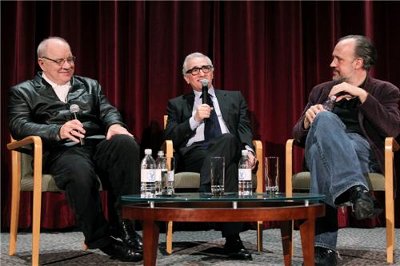
Celebrating the 35th anniversary of Martin Scorsese‘s seminal film Taxi Driver, Sony Pictures and The Film Foundation, Scorsese’s film preservation non-profit, held a premiere screening of their 4k restoration of the film at the DGA in New York City last night, which also included a conversation with Scorsese and Taxi Driver screenwriter Paul Schrader moderated by critic Kent Jones.

The restoration, which will be available on Blu-ray on April 5 and screening theatrically at AMC theaters beginning March 19 (NYC’s Film Forum will show a new 35mm print starting the 18th), took most of 2010 for Sony to accomplish. According to a flier given to audience members last night, the original Taxi Driver negative was scanned with a specially designed wetgate 4k scanner at Cineric in New York with color correction completed at Colorworks (which also created the new 35mm negative), all under the supervision of d.p. Michael Chapman and Scorsese. Scorsese said last night he strived to have the restoration look as close to its premiere in 1976, going as far as making sure the Columbia logo at the start of the film looked as grainy as it did back then.

Being a part of the VHS generation, I jump at the chance when I can see one of my favorites on the big screen. The digital 4k projection is fantastic. The neon signs in dingy Times Square circa ’76 (Scorsese says he doesn’t miss how Times Square was back then, but doesn’t like what its become either) really pop and you can notice more the strain on Travis Bickle’s sleep deprived face, particularly the bags under his eyes in some scenes. But where I felt the biggest difference was (and what I can never appreciate fully watching on my TV) is the desaturated look for the film’s gruesome finale (one of the tactics Scorsese needed to do to get the film from an X rating to an R). The striking difference in color made me see the scene in a disturbing new light.
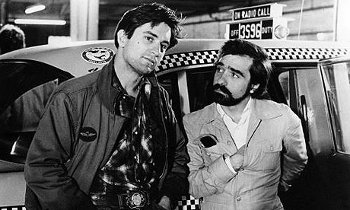
During the conversation portion, which happened before the screening, Schrader talked about … Read the rest

“OFF DUTY” — FINAL DISPATCH FROM INDEPENDENT FILM WEEK

By

Thursday, September 30th, 2010

Goodfellas.  I can almost always watch it.  Don’t know how many times I have seen it. Scorsese was attracted to Little Italy’s urban grittiness.  But he knows that idolizing these figures never works. Joe Pesci scenes are always great.  But I never inspired to be Pesci or anything like that. Lessons learned from Goodfellas…try to treat everyone with respect and don’t talk too much.

(Click to watch Goodfellas Trailer)

-Richard, Taxi Dispatcher

So IFP’s Independent Film Week came and went and what do I have to show for it?

Taking lessons from Richard I tried to treat people with respect, but I definitely talked too much.  I also had great meetings with broadcasters (BBC, DR), sales agents (Films Transit, Louise Rosen), and film festival programmers (Berlin, Film Forum).  But what this year’s market reinforced to me was that making films is a wonderful thing to do.

There were many passionate and driven people who are creating unique projects.  I am especially excited about David Redmon and Ashley Sabin’s finest work to date Girl Model, where they imbed themselves in the lives of Russian teenagers seeking modeling careers in Japan.  It is also their fifth film in five years, God bless that couple!  Another project that tickled my fancy was Jason Osder’s Let the Fire Burn about the Philadelphia police dropping two pounds of C-4 explosives on an anti-establishments group’s house and letting the entire block burn down.  Bess Kargman’s First Position is an entertaining film about children ballerinas that is exquisitely shot by Nick Higgins.

A select few films each year will make money and win accolades, but most of us make films because we do not want to be insurance salesmen.  The music producer Steve Albini and member of the band Big Black fervidly explains why he has to make music.

“I would shoot myself in the face if I didn’t have some way to blow off steam. And because I don’t like sports, and because I don’t like disco dancing, and because I

Read the rest

WHAT’S IN MY INSTAPAPER: SUNDAY MORNING LINKS

By

Sunday, August 29th, 2010

Here are some links that caught my eye this week.

The Workbook Project has a new Transmedia Talk Podcast. Topics include “The Web is Dead,” Foursquare, and the Transmedia panels at SXSW 2011.

Also at the Workbook Project, Mark Harris on why he shot his forthcoming The Lost Children fiction feature as a doc.

Sarah Kessler at Mashable: “New Neutrality — Seven Worst-Case Scenarios.”

There’s been a lot of interest in NYC writer Tao Lin over at The Rumpus. I haven’t read him, so I can’t comment. But here’s an intro at Salon that also discusses the new ways he’s figured out how to monetize his work. An excerpt:

In early November 2009, Lin held an “experimental contest” on his blog that invited users to bid a certain amount of money via Paypal — any amount they chose — on a prize package of Tao Lin goodies. The catch: Lin’s prizes would go to the highest bidder, but entrants would not get their money back if their bid lost. Lin posted a video that showed off the prizes: A “unique drawing of a Sasquatch holding a hamburger,” which he notes has the “crying hamster stamp of authenticity” (a small doodle Lin puts on all his artwork and also signs books with); a Tao Lin T-shirt; an unpublished draft of a short story; an error-filled galley copy of Shoplifting From American Apparel; and a small Moleskine journal filled with Lin’s notes. “You can find out exactly what I do by getting this and looking at my to-do list,” he declares in the video. One finds all of this thoroughly ridiculous until learning that the last Moleskine notebook he sold on eBay went for $80. He is making real money off of this shwag. Lin says, “I probably make $700 a month from selling stupid things on my blog.”

If you’re wondering, in fact, how much writers make to see if they make more than independent filmmakers, then head over to The Rejector for a detailed piece entitled, yes, “How Much Does a Writer Make?”

At Arron La, a developer… Read the rest

MARTIN SCORSESE’S SHE SAID YEAH

By

Thursday, August 26th, 2010

A promotional short for Bleu de Chanel that seems to be comprised of the shards of more than one complete movie. Score by the Stones. Hat tip Movie City News.

Read the rest

U.S. DIRECTORS CALL FOR JAFAR PANAHI’S RELEASE

By

Saturday, May 1st, 2010

A powerful statement from U.S. directors calling for the release of director Jafar Panahi from prison in Iran has been issued. I’ll let the petition speak for itself, but kudos to the organizers for taking action and assembling this illustrious group.

New York, NY (April 30, 2010) – Jafar Panahi, an internationally acclaimed Iranian director of such award-winning films as The White Balloon, The Circle, Crimson Gold and Offside, was arrested at his home on March 1st and has been held since in Tehran’s notorious Evin prison. A number of filmmaking luminaries have come to Mr. Panahi’s defense and “condemn his detention and strongly urge the Iranian government to release Mr. Panahi immediately,” according to a new petition. (Petition text and full list of signatories is available below.)

Islamic Republic officials initially charged Mr. Panahi with “unspecified crimes.” They have since reversed themselves, and the charges now allege that he was making a film against the regime, a very serious accusation in Iran.

Mr. Panahi’s films have been banned from screening in Iran for the past ten years and he has been kept from working for the past four years, but he continues to stay in Iran.

“Mr. Panahi deeply loves his country,” says Jamsheed Akrami, an Iranian-American film scholar and filmmaker, who helped organize the petition. “Even though he knows he could have opportunities to work freely outside of his homeland, he has repeatedly refused to leave. He would never do anything against the national interests of his country and his people.”

Mr. Panahi is one of the most heralded directors in the world. He has won such top prizes as the Silver Bear at the Berlin International Film Festival for Offside (2006), the Un Certain Regard Prize at the Cannes Film Festival for Crimson Gold (2003), the Golden Lion at the Venice Film Festival for The Circle (2000), the Golden Leopard at the Locarno International Film Festival for The Mirror
(1997) and the Cannes Camera d’Or for The White Balloon (1995).

PETITION: Free Jafar Panahi

Jafar Panahi, the internationally acclaimed Iranian director of such award-winning

Read the rest

VOD CALENDAR

Filmmaker's curated calendar of the latest video on demand titles.
Contagion The Guard Hell And Back Again
See the VOD Calendar →
Filmmaker's Best Of 2011

Entries (RSS) and Comments (RSS)

The Filmmaker Magazine Blog is powered by WordPress.org.