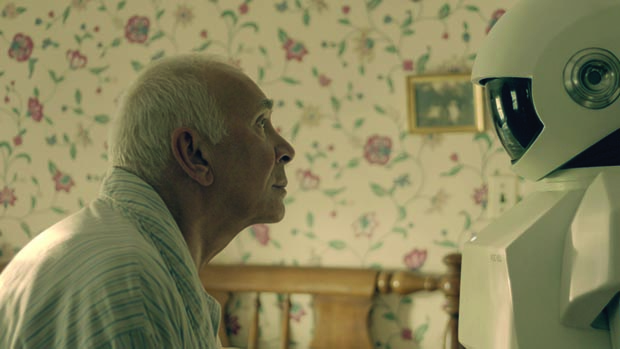
Sundance 2012
Monday, February 6th, 2012
I empty my pockets of biz cards, coffee receipts and contacts written on scraps of napkins and sing-think to myself, ala Rosemary Clooney – “Is that all there is?…”
“Let us know when you want to have dinner” a filmmaker Sundance vet texts. “The post Sundance blues are real. Believe it.”
These thoughts must be truthfully reported in this blog even though reading about luxury problems like this would typically make me want to punch the writer.
I was secretly expecting that once you got into Sundance you simply had to hand out butcher tickets to distributors and dig out lotto numbers to the lucky agent who wanted to rep you for a four-picture deal (halfway kidding).
After the crest of the Sundance festival week began to cascade, I fell into contrast and compare mode as news of films selling felt like a backwards Contagion where no one would sneeze on me.
Truth be told, only 20% of features have sold so far but once you get into Sundance, greed kicks in and you want to be in that top 20%. The last third of the festival, a lot of directors start getting murky and mopey.
On one particular night at sushi I excused myself from my crew to go to the bathroom. Overwhelmed, I was looking for the chance to be alone then unwittingly walked right out into the adjacent Mexican restaurant where my cast was eating by the door. “Hey!!!” This happens to actors too, one who admitted with an unblinking smile, “Uh, yeah. I’m ready to go home.”
After the festival, I flew into Newark, NJ and took the bus to Port Authority. Halfway to Brooklyn on the A train I realized I left my bag on the bus at 42nd Street.
An hour-and-a-half later I found myself standing beside the radio dispatcher at Port Authority. “Oh, you’re the one with bag.” He smiled. “The bus driver called it in. He’s coming back off his loop in about 4 minutes.”
“What bag?” the returning bus driver chided before chuckling and throwing open the hatch to reveal my luggage.
As … Read the rest
Tuesday, January 31st, 2012
Stephen and Patrick from the National Film Society are back with one last Sundance interview. And they’re going in style, sitting down with Nicholas Jarecki, director of the hedge-fund thriller Arbitrage, for what Jarecki refers to as “without a doubt the weirdest interview I’ve ever done.” One of the big hits of this year’s festival, Arbitrage sold to Lionsgate and Roadside Attractions for a deal reportedly in the $2.5 million range.
Video Highlight: Jarecki hilariously describing some unexpected sexual tension during his first meeting with actor Richard Gere. Watch that, and more, below:
… Read the rest
Monday, January 30th, 2012
Sundance 2012 is in the wind, but Stephen and Patrick from the National Film Society are back with another interview they filmed during the festival. This time out, the duo sit down with director Terence Nance (An Oversimplification of Her Beauty) and actress Namik Minter. Minter and Nance, who spent over half a decade readying Oversimplification, are good sports, answering Stephen and Patrick’s questions about their favorite part of being in love, their least favorite part of being in love, and how to get into Sundance parties.
Watch the interview:
… Read the rest
Sunday, January 29th, 2012
With Sundance wrapping up tomorrow, this year’s award winners were announced at a ceremony tonight in Park City.
Perhaps unsurprising considering the amount of critical acclaim it’s been garnering this past week, Benh Zeitlin’s Beasts of the Southern Wild took home the Dramatic Grand Jury Prize. Meanwhile, Eugene Jarecki’s War on Drugs critique The House I Live In won this year’s Documentary Grand Jury Prize, and Mark O’Brien’s crowd-pleasing drama The Surrogate took home the Dramatic Audience Award.
The full list of winners:
Grand Jury Prize, Dramatic:
Beasts of the Southern Wild
Grand Jury Prize, Documentary:
The House I Live In
World Cinema Jury Prize, Dramatic:
Violeta Went To Heaven
World Cinema Jury Prize, Documentary:
The Law In These Parts
Dramatic Audience Award:
The Surrogate
Documentary Audience Award:
The Invisible War
World Cinema Dramatic Audience Award:
Valley of Saints
World Cinema Documentary Audience Award:
Searching For Sugar Man
The Best of NEXT Audience Award:
Sleepwalk With Me
Directing Award, Dramatic:
Ava DuVernay, Middle of Nowhere
Directing Award, Documentary:
Lauren Greenfield, The Queen of Versailles
World Cinema Directing Award, Dramatic:
Mads Matthiessen, Teddy Bear
World Cinema Directing Award, Documentary:
Emad Burnat and Guy Davidi, 5 Broken Cameras
Waldo Scott Screenwriting Award:
Safety Not Guaranteed
World Cinema Screenwriting Award:
Young & Wild
Documentary Editing Award:
Detropia
World Cinema Documentary Editing Award:
Indie Game: The Movie
Excellence in Cinematography Award, Dramatic:
Beasts of the Southern Wild
Excellence in Cinematography Award, Documentary:
Chasing Ice
World Cinema Cinematography Award, Dramatic:
My Brother The Devil
World Cinema Cinematography Award, Documentary:
Putin’s Kiss
Special Jury Prize: Dramatic (Acting):
The cast of The Surrogate
Special Jury Prize: Dramatic:
Jonathan Schwartz and Andrea Sperling for producing Smashed and Nobody Walks
Special Jury Prizes: Documentary:
Love Free or Die
Al Weiwei: Never Sorry
World Cinema Special Jury Prize: Documentary
Searching For Sugar Man
World Cinema Special Jury Prize: Dramatic
Can
Alfred P. Sloan Prizes
Robot & Frank
Valley of Saints
Sundance/NHK International Filmmakers Award:
Jens Assur, Close Far Away
Short Film Audience Award:
The Debutante Hunters, directed by Maria White… Read the rest
Friday, January 27th, 2012
Does the culture make the artist, or does the artist make the culture? Two Sundance documentaries — Shut Up And Play the Hits, which follows James Murphy through the last concert of his band LCD Soundsystem in 2010, and Under African Skies, Joe Berlinger’s history of Paul Simon’s seminal Graceland – might seem to be unlikely bedfellows. Both films are brilliantly executed portraits of musicians walking the tightrope of cultural relevance and personal expression. The differences between the two stories illustrate fundamental changes in our popular culture over the last 30 years.
Both films seek to explore “a moment in time.” For Under African Skies, that’s 1986, the year Simon released his celebrated and controversial album Graceland. His prior album, Hearts & Bones had flopped, providing his first taste of anything but wild success since the ‘60s. “I felt liberated,” explains Simon, not having the record companies on his back expecting hits. “I could kind of just do what I wanted.”
So he accepted an invitation to spend ten days in South Africa. “Intimidated” by the albums of local musicians like Lady Smith Black Mambazo and Miriam Makeba, Simon nevertheless got everyone together to jam. “There were babies in the studio… it was a big party…” The album – which involved further recording in London and New York with the South African singers and musicians, plus an appearance on Saturday Night Live – was a smash. But backlash came quickly, as anti-apartheid groups insisted that Simon had violated a cultural ban in place to protest apartheid, and black American groups accused him of exploiting black musicians for his own gain. Simon ignored their complaints, and set off on a world tour that was widely protested and frequently paused for bomb threats. He arranged a concert in Zimbabwe, and encouraged his South African band to sing their national anthem on stage. While everyone who was part of the tour declares their total affection for Simon and unified disagreement to those who opposed him at the time, other voices from South African political groups contextualize the controversy into … Read the rest
Friday, January 27th, 2012
The Year of the Dragon calls for boldness, passion and power. What better way for Sundance to usher in the new year than a dragon dance up and down the aisles of the Yarrow Theatre? Cavorting to drums and cymbals, the dragons were introducing the world premiere of the documentary, China Heavyweight.
China Heavyweight is the second feature-length doc from Montreal’s Yung Chang, who helmed the award-winning Up The Yangtze. Chang follows coach Qi Moxiang and his two boxers, Zongli He and Yunfei Miao, in southwestern China as they train for the championships. The area they come from is poor, isolated and a breeding ground for kids looking for a way out. One way is boxing. These kids dream of being world stars like Mike Tyson, amazing given the fact that during his reign Chairman Mao Tse-tung banned pugilism for being violent and decadent.
Like Up The Yangtze, China Heavyweight is an observational doc in the style of Frederick Wiseman. It is beautifully shot and edited, preferring to eavesdrop on intimate conversations between anxious parents who want only the best for their sons, and the boys themselves who train 24/7. Some will be disappointed that Chang doesn’t hype the Big Bout that climaxes the film, but his sympathy for his subjects is palpable. In one touching moment, a tearful mother weeps in a corner of the house, because she fears the beating her son will take in the ring.
Though Chang’s family hails from China, it was actually co-producer and sinophile Peter Wintonick who pitched the idea to him. At the premiere, Wintonik and the other producers at EyeSteelFilm, also known for the superb Last Train Home, watched as the normally cool and relaxed Chang choked up during the Q&A when he introduced the coach as his “brother.” Several in the audience awarded Qi a standing ovation. Chang later reported that Qi was “in tears throughout that screening.”
Audience reaction was warm to Heavyweight though some inevitably compared it to Up The Yangtze, though the subject matter is miles apart. Yangtze is about surviving colassal change in modern China … Read the rest
Friday, January 27th, 2012

One of the trickier things about reviewing movies at a festival is that your identity isn’t exactly a secret. You’ve got a press pass with your name and the name of your outlet on it, so a lot of conversations you have with filmmakers revolve around that very fact. Or you end up in a long conversation at the Kickstarter party with the director of a film you hated. But my philosophy is if you can’t stand face-to-face with someone and defend your opinion of their work, then you have no business telling it to anyone else. Comments and critiques from behind the veil of anonymity are cowardly and childish and harmful. There’s no place for them in the indie film community.
Which brings us to Daniel Martinico’s Ok, Good, essentially a one-man show of struggling actor Hugo Armstrong and his endless string of rejections. We watch Armstrong go through commercial audition after commercial audition, all of them for things like laundry detergent and potting soil and any number of things you don’t necessarily care about.
But Armstrong cares. He cares deeply, spending hours poring over scripts and rehearsing even the simplest things like how he introduces himself to the casting director. He’s meticulous. Maybe too meticulous. He finds a flaw in the duplication of his headshot, and the rectification of that pretty much becomes his life mission for awhile.
It wears on him and we start to see his processes fall apart, little by little. All the while, he’s attending these acting workshops where a bunch of actors pace around a room, screaming at each other and doing some bizarre form of yoga and, well, all sorts of weird shit. It’s all very primal and you half expect them to be getting psyched up for a football game. But I guess that’s what they do.
What’s probably most impressive about Ok, Good is the cinematography. Martinico shot it himself and it looks fantastic, with an attention to detail that dovetails beautifully with Armstrong’s preparations. The audition footage looks appropriately terrible, but everything is well-frame, each shot serving … Read the rest
Friday, January 27th, 2012
I’m leaving Sundance this year was the longest list of films I missed but really want to see then ever before. At the very top of is Room 237, Rodney Ascher’s treatise on the multiple meanings viewers have constructed from Stanley Kubrick’s The Shining. “Discover why many have been trapped in the Overlook Hotel for over 30 years,” is the film’s beguiling tagline. Here, via Lance Weiler’s Text of Light, is an excerpt about the music.
… Read the rest
Friday, January 27th, 2012

Independent film, depending on how you define it, has had many births. But for the purposes of this blog post, let’s consider the one in the 1980s, just before the launch of this magazine. She’s Gotta Have It, Parting Glances, Poison, True Love — these were narrative features made by lone filmmakers with a mixture of private money and, sometimes, foreign TV deals, and they were released into the marketplace after being acquired by independent distributors who catered to arthouse audiences. More films followed — Clerks, El Mariachi, The Blair Witch Project — and the idea that one could possibly be not just a filmmaker but an “independent filmmaker” was born.
Of course, things change, and I wonder if a new generation for whom media creation is simply part of life even cares about that self-definition. Is making a movie that special anymore? Maybe the ones who really care about the meaning of “independent” are in other fields, like video games. Case in point: the creators profiled in Lisanne Pajot and James Swirsky’s Sundance documentary Indie Game, who evince all the blood, sweat and tears we like to claim as the hallmarks of the independent filmmaker. More importantly, they are creating games during a historical moment that feels both somewhat new and not unlike the rush that the filmmakers behind films like, say, The Blair Witch Project, must have felt when their homemade creations suddenly burst forth on 2,000 screens.
Pajot and Swirsky interviewed 25 game designers before narrowing their film’s focus to three. Braid creator Jonathan Blow (pictured above, at right, with Pajot and Swirsky at the Sundance Q&A) is the eminence grise, the obsessive elder statesman who revolutionized the indie game world with a work that was not only fun to play but emotionally rich. That an indie game could make such an impact, scoring mainstream reviews and selling in the hundreds of thousands of downloads, inspired the film’s other two game designers. Designer Edmund McMillen and programmer Tommy Refenes are the team behind Super Meat Boy, an anarchic … Read the rest
Friday, January 27th, 2012
The role of authority in the lives of everyday people is a crucial question at this year’s Sundance Film Festival. From the first wave of documentaries examining the Arab Spring to fictional accounts of the personal and collective consequences of confronting our conception of power, Sundance filmmakers this year have looked at the state of our world and our culture and uncovered a complex battle for control. Of the standout films I have seen at Sundance this year, for one reason or another, the issues of control and responsibility have played a crucial part in giving this edition of the festival its distinctly dystopian tenor; there is a decidedly downbeat feeling up here in the thin, frozen air, a sense that something is truly broken.
Front and center in my mind is Craig Zobel’s Compliance (above), a film that is inspiring a great deal of debate among viewers. The film tells the story of a young female employee at a fast food restaurant who, after her manager receives a phone call from a police officer, is subjected to confinement and, ultimately, physical and sexual humiliation at the hands of her employer. The film, which spends most of its time within the tight quarters of the restaurant manager’s office, is a study in Kafka-esque economy; a woman accused of a crime she may or may not have committed acquiesces to the abuse of her captors, who are themselves driven by a disembodied voice on the phone that exerts a perverse authority over their actions.
The film is deeply chilling, not just for what it proposes about human nature, but for Zobel’s extraordinary skill in creating a visual strategy that uses cinematic space to express the role playing and relative power of each of his characters in the frame. The result is a daisy chain of, well, compliance, with small clusters of authority and subordination recreated in the film’s geometry, giving a deep resonance to the film’s exploration of the brutality of capitalism in the era of Guantanamo.
Of course, not everyone sees the film this way; many have become fixated on the details of the story and the veracity … Read the rest