Back to selection
“Women Directors are One More Problem We Don’t Need”: Joan Micklin Silver on Chilly Scenes of Winter
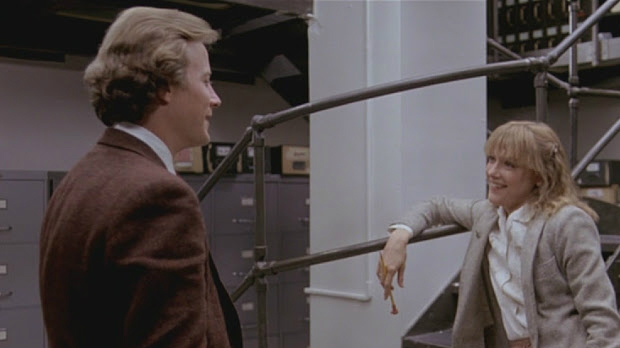 Chilly Scenes of Winter
 Released in 1975, Joan Micklin Silver’s feature debut Hester Street is the story of immigrant Jews assimilating with various degrees of success to turn-of-the-century New York City. She followed with two contemporary works: 1977’s Boston alt-paper story Between the Lines and 1979’s Chilly Scenes of Winter. The latter is set to screen tomorrow at NYC’s IFC Center as part of the “Celluloid Dreams” series, whose premise would not have made sense in the very recent pre-DCP past: it aims to show repertory cinema on 35mm.
Chilly Scenes is based on Ann Beattie’s first novel, which primarily concerns itself with Charles (John Heard) and his deathless, unwanted passion for long-gone Laura (Mary Beth Hurt). Given sympathetic company by his pal Sam (Peter Riegert), Charles indulges in behavior we’d now consider to be definitely on the stalker end of the spectrum; at one point the two friends pretend to be a gay couple looking at houses solely so they can get a look at Laura’s new real estate agent partner as she watches uncomfortably. This plays out against the bleak, cold and decidedly charmless confines of Salt Lake City, a transposition from Beattie’s usual east-coast-WASP battlegrounds that works. The vibe is surpassingly late-’70s in the best ways: everyone seems both tired of everything and vaguely amused that this is how things have worked out in their lives.
Hester Street was a big success upon release; both that and Between the Lines were produced by Silver’s late husband Raphael and self-released through Midwest Films. (This interview, conducted after the latter, is a good introduction to Silver’s career at the time.) Chilly Scenes of Winter was her leap to the studio system, a process which didn’t go smoothly. As James Atlas explained in The New York Times, it took three years for the film to find its audience: initially retitled Head over Heels and released with a happy ending, the film flopped and it’s still yet to be fully rediscovered to the degree it deserves. The film’s determination to be nice to often “unlikeable” characters can make it a tough proposition for some viewers, but it’s a fascinatingly complicated work. Prior to the screening, Silver spoke with me about how John Cassavetes helped her early career in self-distribution, the difficulties of breaking into filmmaking as a female director and the joys of collaboration.
Filmmaker: On your first two films, you and your husband had had to set up Midwest Films and get into the business of distribution and battling for screen space with help from Jeff Lipsky, who came over from John Cassavetes’ organization.
Silver: I don’t think too many people had what I had, a husband who believed in me and who wanted to help me. I tried very hard to get work; I could get work as a writer but not as a director. At that point in time, women directors just didn’t get jobs. I remember going to see one producer from one of the studios, and he said to me, “Feature films are expensive to make and expensive to market and women directors are one more problem we don’t need.” I can’t imagine anything that blatant now. They might feel that way now, but they wouldn’t say it, I don’t think. I got so depressed. I thought it was hopeless.
So I got depressed, but Ray got angry. He said, “Listen, if you can find a movie that you want to make, and if you can make it for” — I think he said $300,00 or $350,000, he would raise the money and produce it for me. I thought I would probably only get to make one movie in my life, and I wanted to make one that counted for my family. My family were immigrants, and especially my father had memories, because he came over at 12. He was one of those immigrants that talked about it all the time. Some of them do and some of them don’t. Some of them don’t want to talk about it all, they just want to get on with it and be as Americanized as possible, but he told all the stories and remembered it all.
Up until that time, the movies that I had made were for audio-visual companies that made movies for schools — high school students, that kind of thing. For one of them, the subject was immigration, but I was told that I couldn’t use Jews because they were too atypical. I was given a choice of Poles and Germans. I picked Poles because in Brooklyn there was a large Polish community. I thought that way I could hire people who spoke Polish and knew this whole thing, and I did and I made the movie and it won little prizes the way all people’s short movies did. I thought that I would be able to go from there to making features, as had many male directors, but I couldn’t. So when I got my chance, I made Hester Street.
The way people thought about material — I can remember one person saying to me, “Jews are two percent of the population.” And I said, “Well, maybe somebody’s gonna come besides Jews.” I know when I did the script of Hester Street, one woman who worked for one of the studios told me that if I changed them to Italians, they would be interested. I don’t know where people get these ideas, but they have them, so it was kind of depressing for me. I certainly wanted to tell the story that I knew from my family, and I didn’t see why their story wasn’t applicable to everybody’s story.
After we made it, nobody wanted to distribute it, and that’s when Ray called up John Cassavetes cold — didn’t know him. Cassavetes was so nice. He told him the problem, and Cassavetes said, “Well, why don’t you distribute it?” And Ray said, “Well, I want to, but I don’t know anything about it. I’m not in the film business.” He said, “Well listen, I’ve got two guys that are working with me, I’m done with them, they just finished a project. If you want to, meet with them and they can help you.” One of them was Jeff Lipsky, and Ray and Jeff — I’m sorry, I’ve forgotten this other guy’s name — distributed the film. One of the things that Ray wanted to do was to take it to the Cannes Film Festival, so he submitted it. They accepted it, and it did very well there, and we sold the rights in various countries, and we had enough to open it.
The day that it opened in New York, it played at the Plaza Theatre, on 58th between Madison and 5th. The prevailing wisdom at the time was that you didn’t want bad weather — people don’t go out of their house. You didn’t want great weather — people want to go and be outside. You wanted in-between weather. That was the conventional wisdom of the day, and of course I believed everything I heard. The day that the movie opened, it just poured. It was a terrific rainstorm. Ray said, “Well, we might as well stay home. Let’s watch the football game.” But Jeff called and said “Come over,” and there was a huge line of people with umbrellas, and Carol Kane’s mother took a photo of the people with the umbrellas to prove that there was this big line. People were waiting for the movie, you know? They wanted the movie it arrived, so it was great luck.
Filmmaker: You grew up in Omaha, right? Was there a Jewish community there?
Silver: Yeah. It wasn’t huge, but there was a reform congregation, a conservative congregation and an Orthodox congregation. I was bat mitzvahed. If you could possibly afford it, you joined all three because that helped the people that couldn’t. I grew up feeling very, very aware of being Jewish and feeling proud of that. I went to school and I remember classes where I was the only Jew, and I would know that because I was the only one who wasn’t in school on the holidays.
Filmmaker: When Ann Beattie started publishing a story every half year or so in The New Yorker in the ’70s, is that when you became aware of her work?
Silver: I did read her stories, because I’ve been a New Yorker reader for a long time, but it was the novel that really got to me. You always have the problem when you read a great novel that you won’t be able to use everything. Many things have to be left of the screenplay for a book that’s as full as that one. I just started with what seemed to me to be the key thing and then let it spread from there, but not quite as widely as she did.
Filmmaker: The first time I saw Chilly Scenes of Winter, I hadn’t read any Ann Beattie; your movie got me started on her. So when I watched the film a second time, it was obviously a very different experience, and it seemed to me that you’re much less severe on her characters than she is.
Silver: Well I’ll tell you, I didn’t do that so much. In the book, you see Charles in a number of situations with a number of people. What I did was play those down and concentrate on the relationship with Laura, which is what I thought the book was about. The appeal of it is that everyone has, at some point in his life, loved someone more than that someone has loved him. You could say that about everybody in the world, practically, and that to me what was so gripping about bringing this story alive. The second thing that was so important to me was I had just worked on Between the Lines, where I had a wonderful group of actors, and one of them seemed to me that he would be so right for the part. So from the directorial point of view, when you’ve got somebody that you think can play the part, that makes it all the more interesting.
I had the shock of my life when I tried to get the rights to the book. I discovered that the rights were already taken by these three young actors. I couldn’t believe it. I said, “They have my book!” I was so stunned, but I met with them and told them that one of my conditions be that John Heard play that role, and they all said that that’s exactly what they wanted. They were all young actors, they knew his work, so we got along wonderfully. They were good producers and good actors. It was my intention — my hope and my little dream — to write the script with Ann. I can’t remember where she was living, maybe Washington or something like that, and I figured that we could get together. I proposed this to her at our first meeting, and she said “I don’t want to do the script.” I said, “You don’t?” She said “No, but I want to be in the movie.” And I said, “Well, I didn’t know you’re an actress.” And she said, “I’m not. I want to play a waitress.” I said, “There actually is no waitress in the script.” She said, “Well, can’t you put one in?” I said “Yeah, I can.” So she played a waitress with no lines.
I must say she was extraordinarily generous. I remember after the movie was over, she and I spoke at some place in Baltimore, and the person asking the questions was asking about different things that were in the movie that were not in the book. He asked Ann if she minded, and she said “No, if I’d thought of them, I would have put them in the book myself.” The most generous author I ever heard of.
When I finished Chilly Scenes, the studio didn’t like it at all, and they dumped it. They thought it was stupid and uninteresting and I don’t know what they thought, but they certainly didn’t think they were going to make any money off of it. They put it out as a second feature with some movie, it was just dumped. What resuscitated it was that United Artists had a classics division, and they loved it and wanted to put it out on the condition that I would bring the name back, because it had been changed to Head Over Heels, which was the worst blow. They thought nobody would see a movie called Chilly Scenes of Winter, it’s depressing. To me it’s a beautiful title, I adore it. By that time, I had shown the film to various groups, and that’s a big help to a director, because you find out things that you thought were playing and adjustments you can make, and I had gone through that process and could see that the ending — although satisfying in the book — was not satisfying in the movie, and what the audience wanted was for him to get over his obsession, because the movie had been so totally about his obsession, even more than the book. That is the book, but he also has many other things going on in the book that I didn’t have room for. So I cut off the last scene, and that seemed to work.
Filmmaker: Why Salt Lake City?
Silver: We wanted to make it in Albany. We all lived in New York, the three producers and I and the cast that we wanted. We went up there, and the Teamsters made some very difficult demands. At one point, one of the producers said “We can’t afford that. We’re just a little company making a little film. We won’t be able to make the movie here unless you give us a break.” And they said “So don’t make the movie.” It’s sad, because there were a lot of people in Albany who would have wanted to work, but they had all sorts of conditions that we couldn’t possibly afford to meet. So we went around. We wanted to be in the capital of a state, because that’s what he’s doing, his job is a governmental job. I think they just found that Salt Lake worked out best for them for that.
Filmmaker: Do you rewrite scenes to play to your actors’ best strengths?
Silver: You talk about it and you talk to them about it, and then they have ideas and then you have ideas. I alway saids to the actors, “You can try anything, but in the end I’ll decide whether we’ll do it or not.” We had a really wonderful working relationship. They all were a pleasure.
When I finally got a chance to start making movies, I was almost 40, and I didn’t want to go back to film school. I would have if I had been able to earlier, but now I just wanted to make movies. What I did was two things. One was I went to the Museum of Modern Art. I lived there looking at movies. The other thing I did was read books by directors. One of the ones that made the biggest impact on me was Elia Kazan, who wrote very honestly and interestingly about his experiences as a director. One of the things he said was that the director has to have a mano a mano with his main character, and he has to win it. I didn’t seem to need it on Hester Street, and on Between the Lines nothing came up. So we got to Chilly Scenes and we were doing one of the scenes. It was John and the girl who played Betty. They were sitting at a dinner table. I did a wide shot and I wanted to come in for coverage. I went in to John and said “Cut” and said “John, this doesn’t match the master.” And he said “So what?” I thought, my mano a mano is here. Of course, when that happens everyone’s very interested, the crew wants to see the fireworks. I said, “Well, I like it better the other way.” He said, “Oh, OK.” So that was my mano a mano.
I like actors, I like working with actors. I’ve found when I go to a movie, if I see an actor, a role that is really really good, that I will feel so positive about that movie in a way that maybe that movie doesn’t even deserve, but I get very excited about the skills of actors. I loved working with actors like Peter and John, who were so full of ideas and life. And Mary Beth was great, and Gloria Grahame —
Filmmaker: How was working with her?
Silver: This is what you get when you have producers who are three actors. There used to be a program on TV where they would show one movie seven times every night, late at night. They showed one of her movies and we all saw it and said, “That’s the mother.” So we met her and she seemed just wonderful and was perfectly cooperative. She loved John and she loved the role. Everything went fine, but there was one line, which was in the script. I think I took it from the book. I think it was “I’m 57 and I’m not dead yet.” She wouldn’t say it. And I said, “Why not?” And she said “I’m not 57.” I said well, of course you aren’t, but the character is, so you can use it as a character. She wouldn’t do it and I could not get her to do it.
Filmmaker: Do you prefer to do the minimum number of takes, or do you like to do more?
Silver: So many directors that I admire do things in two takes, like Lumet, and then there are directors like Arthur Penn, who did 40 takes. Whatever works for you, but I like to get it, and once I’ve got it move on. I don’t keep doing it to see if anything else will come. I haven’t ever had where I’ve had so much time or money where I would have had the time to do 40 takes.
Filmmaker: And what was your approach to shot composition and working with the cinematographer? You didn’t seem very interested in being visually ostentatious.
Silver: I remember Hester Street was the first one where I said to Ken Van Sickle, “I think we should put the camera here,” and he would say, “Well we could do that, but you know what? We could also put the camera here.” And of course right away I could see that that was a much better idea. I think they kind of liked it, because a lot of young directors who are inexperienced, at least at that time, didn’t want anybody giving them any advice, and I didn’t feel like that at all. I didn’t have the slightest hesitation in asking anybody to help with anything. Whether it’s being a female or that’s just me, I didn’t feel diminished at all by saying “What shall I do here?” or “Who’s got an idea?”
Filmmaker: Your filmography on IMDB ends with a series of Lifetime movies.
Silver: I got the jobs and made the money. I had fun. They were all in Canada, because at the time that was where you did it to save money, so I shot in Halifax and Toronto and Montreal. I’ve always had a good time with my crews and my cast, I’ve always been lucky enough to work with people I enjoy working with and get a kick out of the whole thing. Those are projects that I didn’t write, I was the person who was hired to direct them, whereas things like Chilly Scenes I felt like I was a part of the whole thing from the beginning. You’re doing it and you have a chance to do it, but you haven’t had a chance to make changes or invent, but they were jobs of work and I was glad to have them and enjoyed some of them very much.