Interviews
Interviews
Featured
The Day YouTube Wept: Marcus Batto’s Found-Footage Memorial to Michael Jackson
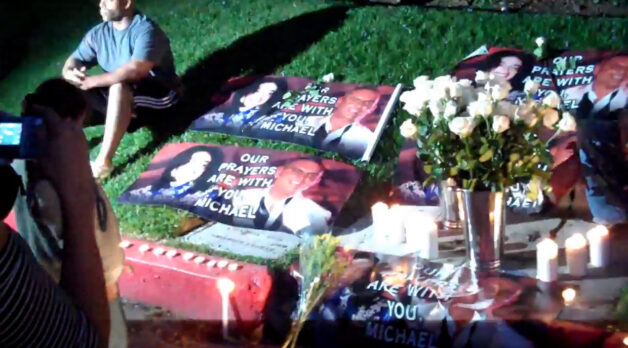 There’ll Likely Be Michael Jackson Vigils Throughout the Night
A day in the life of the internet is impossible to reconstruct as a feature film. The pace of the scroll is too quick; any given snapshot is too algorithmically myopic to be comprehensive. There’s too much that evades notice,… Read more
Personal Effects: Boots Riley and His Collaborators on Crafting I Love Boosters
 Boots Riley BTS on I Love Boosters
Boots Riley has directed two movies and one TV show over the past decade, but he’s been telling stories through music for more than 30 years. “I usually think about my songs the same way I think about movies,” said… Read more
Cannes Interview: Dominga Sotomayor on Her “Spontaneous and Liberating” La Perra
 La Perra
Dominga Sotomayor’s cinema is one of confined spaces. Her features tend to unfurl in tight, growingly claustrophobic settings. In her 2012 debut Thursday till Sunday, the action took place by and large inside a car en route to the beaches… Read more
“I Believe My Instinct”: Tony Leung and Ildikó Enyedi on Silent Friend
 Silent Friend
The Hong Kong actor Tony Leung Chiu-wai has worked with some of cinema’s most accomplished directors. Known for his collaborations with Wong Kar-wai and John Woo, Leung has also appeared in films by Johnnie To, Hou Hsiao-hsien, Ang Lee, and… Read more
-
“A Growing Sense of Freedom”: Sho Miyake on Two Seasons, Two Strangers

Amidst a surge of interest in contemporary Japanese cinema in the West, Sho Miyake is not yet a household name—but his reputation is only growing. Since graduating from the Film School of Tokyo, Miyake has been building a body of quietly considered dramas. In 2012, Miyake released his first two low-budget features, Playback, an Alain Resnais-ian dive into memories of youth, and Good for Nothing, about a group of high-school boys working at a security company in Miyake’s native Hokkaido. His character-driven works often explore group dynamics, like his exceptional summer romance And Your Bird Can Sing. Miyake’s most recent […]
-
Blue Monday: Elliot Tuttle Discusses His Transgressive Blue Film
Blue, as it pertains to the material and sociopolitical histories of cinema, is a color associated with legend, conjecture, and etymological ambiguity. During the heightened moral panic and puritanical tyranny of Hays Code–era Hollywood, blue grease pencils were used by censors to mark film stock for sequences considered obscene or ethically dubious, undermining artistic integrity and forcing directors into eleventh-hour cuts and re-shoots. Concurrently, the lápis azul was used by the Estado Novo dictatorship in Portugal to omit words or entire passages from texts that were deemed politically subversive, as well as to censor international films before they reached Portuguese […]
-
“You Have to Be There”: Barbara Kopple Looks Back on American Dream
Set in Austin, Minnesota, a company town where nearly every resident has a connection to food-processing giant Hormel Foods, Barbara Kopple’s American Dream (1990) embeds with unionized Hormel meatpackers as they respond to a 23 percent hourly wage cut in a time of unprecedented corporate profits. Kopple and her collaborators embedded with the United Food and Commercial Workers Union Local P-9 for a year. The film spans the Austin local’s initial PR push, their tactical disagreements with the UFCW leadership, their protracted contract negotiation process, and, ultimately, their year-long strike from 1985 to 1986. Gathering a wide array of voices—workers, […]
-
“The Wicked Are Punished”: Damian McCarthy on Hokum
Damian McCarthy knows how to scare an audience. At the Hokum premiere at SXSW, screams and giggles filled the theater as festivalgoers jumped in their seats and covered their eyes watching McCarthy’s tightly wound trap spring out at them—sometimes literally—on the screen. The Irish writer-director describes his films as “classic ghost stories,” campfire tales designed to have you searching for faces in the shadows all the way home. They’re elemental, they’re impeccably crafted, and they’re a lot of fun. Hokum is McCarthy’s third feature, and the first time he has worked with a major actor—Adam Scott, who stars as an […]
-
RZA Doles Out One Spoon of Chocolate
RZA, born Robert Diggs, is most well-known as The Abbot, or leader, of the Wu-Tang Clan. Beyond his musical pursuits, however, he has been building an eclectic body of work in cinema for going on three decades. RZA’s cinematic beginnings can be traced to Jim Jarmusch’s elegant, and elegiac, urban samurai riff Ghost Dog: The Way of the Samurai (1999), for which he composed the score and played a minor role. He then appeared as himself in a trio of early aughts comedies: Coffee and Cigarettes (2003), which re-teamed him with Jarmusch; Scary Movie 3 (2003) alongside fellow Wu-Tang members Method Man, U-God, and Raekwon; and Be […]
-
“This Rupture of Utopian Horizons”: Irati Gorostidi Agirretxe on Aro berria
Aro berria, the first feature from Spanish Basque filmmaker Irati Gorostidi Agirretxe, is focused on the revolutionary potential of two spaces: a factory floor and a tent. In the former space, Gorostidi restages the working-class unrest of the late 1970s during Spain’s transition to democracy, opening the film with workers in a San Sebastian water meter plant forming a human snake, their comrades silently putting their tools down and joining in a collective mass. When the more radical workers—many of them young people—fail to sway the plant towards continued action, a number of them leave San Sebastian for the Arco […]