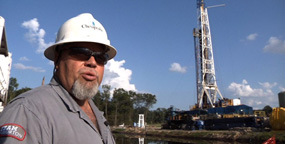
“HAYNESVILLE” AT STF

By in Festival Coverage, News
on Wednesday, June 2nd, 2010

Last night Thom Powers screened two docs, Jessica Edwards‘ short, Seltzer Works and Gregory Kallenberg‘s feature, Haynesville as the penultimate screening in his Spring Stranger Than Fiction series. The series rarely features shorts, but Powers credited the move to the fact that both films focused on gas crises – one very small, one very large, both man-made.

Deftly shot, Seltzer Works is a carefully composed bit of nostalgia for a time when deliverymen schlepped heavy glass bottles full of fizzy water all over Brooklyn. A portrait of a third-generation seltzer man struggling to survive in a world that no longer needs him, Edwards treats her subject with dignity without lapsing into self-seriousness.

Haynesville tells the rather sprawling story of what happens when a very small town is found to be on top of a very big reserve of natural gas. Making a documentary like Haynesville is both an act of faith and an act of cunning – yes, Kallenberg had to trust that events would play out in interesting ways, but he casted smartly, finding subjects with both natural screen presence and storylines that were on an interesting trajectory.

We follow these characters – a suddenly rich landowner who just sold the land he loved to the highest bidder, a local woman who discovers her inner Erin Brockovich and a local preacher who thinks of the natural gas shale underneath his feet as a gift from God – as their lives are forever changed by our nation’s seemingly unquenchable thirst for cheap energy.

Woven throughout are interviews with energy scientists invigorated by what such a large reserve of natural gas means for our energy future. Turns out that Haynesville’s natural gas shale may have granted us a grace period to save ourselves from our gas-guzzling ways.

Haynesville couldn’t possibly be timelier. That black cloud of oil spilling into our nation’s waters has turned an abstract fear into our very real doom. Kallenberg’s impressive act of journalism is both a small shaft of hope in our ever darkening waters and a warning tale about what happens to communities when big energy moves in, both for the better and the worse.

I spoke to Gregory Kallenberg before the screening.

Filmmaker: Which came first, your interested in energy or your interest in Haynesville?

What came first is the interest in Haynesville, the personal story aspect of it. I was working on a different subject about people who had moved back to Louisiana. I was sitting in a café and these two guys walked in straight of central casting, and they were talking about a well.  After hearing them tell it, I perked up my head and discovered these stories were everywhere.

Filmmaker: You’re really there from the very beginning. Did you know from the start that you were going to get a full-length documentary from the subject?

I think one thing to be said for doc filmmakers is we are unbridled optimists. I never questioned I wouldn’t get something. I questioned what it would be.

Filmmaker: How did you approach casting?

We probably started with about eleven stories from all different sides…We wanted to pick three people that gave the embodiment of the time. Some people who didn’t have things go their way said they didn’t want to be filmed anymore and dropped out. Eleven fell to seven real quick, which fell to five, which fell to three, the best of the best.

Filmmaker: At what point did you decided that the more local story of the people in Haynesville needed the global perspective of the energy scientists?

Once we figured out that there was such a vast amount of energy that it was going to change things, that’s when we decided to go out and come up with a larger context. The larger context was what does this natural gas really mean. We were ready for a polarized argument – for the natural gas guys to slams the solar guy and the natural gas guys to slam the back. I think what surprised us is that these people were tacitly agreeing.

Filmmaker: Is shooting in the South easier? Are people less wary of the cameras than in other areas of the country that are more media saturated?

Again, when I started the project, nobody else was on it. I was kind of a novelty… One of the things I do very well is that I am good at meeting people and getting into their personal stories. Der Spiegel and the LA Times did a story, portraying these people as hick lottery winners, and it really upset these people, and we lost some of our stories. People felt that their portrayal was unfair and withdrew. If you betray a Southerner’s trust, they go back to being the most shut off people in the country.

Filmmaker: I went in expecting to experience nothing but doom and gloom and walked out with a feeling of hope. Was that your intent?

I wanted this film to start the conversation. I’ve seen it happened at universities and SXSW and seen people on both sides of the issues come to some sort of agreement… These companies can have the natural gas if they do it in an environmentally safe way that’s fair to landowners… The drill, baby drill people hate my film. The industry does not like my film. Hyper-environmentalists don’t like my film because it says natural gas could be a solution. I do believe there is a rational middle. It’s just up to us to come to a table.

– Mary Anderson Casavant

A graduate of Amherst College, Mary Anderson Casavant was selected as the 2004 Academy of Television Arts and Sciences Documentary Intern. Since then, she’s held almost every freelance job that exists in documentary television, including being the coordinating producer of the Emmy Award winning second season of This American Life. Her feature screenplay, Judgey, was one of ten screenplays selected from more than 3500 entries for the final round of the Final Draft Big Break contest. She lives and works in New York City.

You can follow any follow up comments to this entry through the RSS 2.0 feed.

  • Stewart Nusbaumer

    This is a poor review and worse interview. You cannot intelligently discuss a non-fiction film if you lack sufficient background knowledge. Non-fiction is different from fiction; it requires specialized knowledge about the world, knowledge that transcends movie making. It requires taking the content of documentary and placing it in the context of outside knowledge.

    There is a huge flaw in this film, one so huge that it renders the film worthless — probably worse than worthless since it leads viewers to believe the film’s reassuring narrative. That could be an extremely serious mistake for our country. Remember asbestos? DDT? Believing those happy narratives led to many deaths and birth defects. Remember BP? Remember they said no problem with their drilling?

    Where is the question in the film or from you about the gas extraction process having a negative effect on people’s health? Do you refer to the recent shutting off of people’s tap water in the Haynesville area? Why not? I read about it online. How about the concerns of people from Pennsylvania to California about the health effects from drilling? Why? This is not a small controversy.

    Did you listen to those energy scientists in the film? Wasn’t there something rather strange and uniform about them? Did a single one bring up the scientific data that says we need to be very concerned about this drilling?

    You don’t have to be an expert on this issue – I’m certainly not – for red flags to zoom up, but you do need some knowledge of the issue.

    Independent film can only be as creative and smart and moral as the people supporting the films — the audiences and those part of the larger community. This is especially true for documentaries.

  • http://street-punk-productions.com Mike Johnston

    Hi Stewart,

    Are you turning into some kind of film stalker? lol Your recent piece in the Huff Post made your feelings about the film pretty clear. I guess that wasn’t enough since you now show up here on a totally unrelated website and trash not only the film and the filmmaker but the reviewer as well. Wow, that’s kinda heavy handed for a journalist, isn’t it? Are you going to start commenting on every review that the film gets? If you want to do that let me know and I can supply you with links as they develop. Its a great way to get some publicity for the film :-)

    Personally I like the film. I’m kind of a bitch about honesty though (you can ask Gregory about that) and I think he made the best film he could at the time it was made. When he was shooting the film (2008-2009) the whole “Fracking” issue wasn’t really in the major media yet and definitely not in the area he was shooting in.

    As far as the “gas in the water” incident in Haynesville you mention, that happened at the end of last year or the beginning of this year which was long after the film was finished so it isn’t even related and I think you know that.

    I think the film is balanced. You have environmental concerns being highlighted by the character Kassi in the film and the filmmaker didn’t shy away from that at all. Even the experts he used are balanced over a wide range of opinion. Bill McKibben is pretty Left leaning in his views and famously so. One of the other guys is pretty far right, anti climate change (his name escapes me at the moment) so that is definitely balanced.

    Me? I have been writing about the environment, climate change and alternative energy for a while now. I know quite a bit about these subjects. I know as much as your average scientist about hydrogen energy in particular and natural gas ties into hydrogen energy in many ways (or it can at least). So I guess I’m one of those “experts” you mention in your rant (while at the same time admitting you aren’t one).

    I got involved with T. Boone Pickens; “Pickens Plan” because he made some good points and because he was spending a lot of money to bring alternative energy into the public consciousness. Plus his supporter base included a lot of people from the Right and Left who, within his Plan of national security and energy independence, found common ground on which to agree and that is something you don’t usually see.

    I found this film toward the end of last year and I liked it because I thought it was a balanced look at the potential of natural gas in our transition to a green energy economy. I have been helping Gregory promote the film (as a kind of grassroots supporter, he doesn’t pay me to do it yet)for two reasons. One, because I am interested in our national energy future and I think it is a good film for people to see. Second because I like to promote indie media and have been actively researching ways to do so in the digital world since last year when I started writing about it right here in the Filmmaker blog. I’ve been doing these campaigns totally out of my own pocket I might add (except Gregory did cover some expenses for me).

    Interestingly enough, one of the other films I which I was lucky enough to be able to experiment with promoting was Dawn Mikkelson’s “The Red Tail” which you also reviewed in The Huffington Post. Kind of an interesting coincidence isn’t it? :-) I’m going to take it as a sign that the things I am doing are working rather well…

  • Stewart Nusbaumer

    Are you saying writers can only express their opinion one time? On only one forum? Goodness, that is a drastic position to hold.

    I’m concerned about the issue, you appear to be the one concerned about getting publicity for the film. I think the film stinks. It is an excellent example of what indie films should not be. And I say why I believe this.

    The filmmakers should pull the film. Redo it. As it now exists, it obscures the issue. As it now exists, it’s a great disservice to the American public. Pull the film and rework viewpoints and evidence into the film that currently do not exist. That would be the honorable thing to do.

    The film is a “balanced” pro-drilling industry-supportive film. That is not balance.

    So someone disagrees with you — saying why — and you smear them with the word “rant”? Stay on the issue, and leave the smear campaign to others.

    So now we know that you are on the film team. You are part of the Haynesville promotion team. Isn’t that interesting. You have finally gotten around to saying that. You attack my position and you withhold this extremely important information?

    I have no idea what you are assuming you are doing that is working, all I know is you are promoting a film that is unworthy of being promoted. This is because the film does not encourage discussion and investigation into an issue that has the potential of killing and disabling many Americans. This film wants us to leave the theater feeling peachy we have discovered a miracle to solve our energy problem.

    Well, first we need to see this miracle is not a BP miracle.

  • http://street-punk-productions.com Mike Johnston

    Hmmm, well I guess we will have to let the audience decide those things for themselves, won’t we ;-)

  • http://street-punk-productions.com Mike Johnston

    Stewart,

    Don’t you think you should have identified yourself in your fist comment as a quasi-professional film reviewer who had already written a review of this film in The Huffington Post? I mean you berated me for two days on facebook because I didn’t point out that I was a fan of the film in my response to your post and that I had been helping to promote the film by telling people about it. Then you go and violate your own principles by doing the same exact thing here. tsk, tsk

VOD CALENDAR

Filmmaker's curated calendar of the latest video on demand titles.
Contagion The Guard Hell And Back Again
See the VOD Calendar →
Filmmaker's Best Of 2011

Entries (RSS) and Comments (RSS)

The Filmmaker Magazine Blog is powered by WordPress.org.