Back to selection
D.A. PENNEBAKER & CHRIS HEGEDUS, “KINGS OF PASTRY”
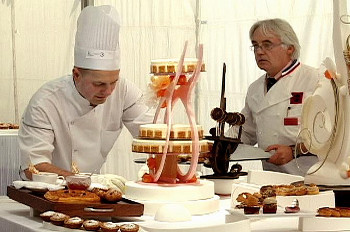
D.A. Pennebaker is a legend in the world of documentary filmmaking. A pioneer in the art of cinema verite, he first made his mark with the 1967 classic Don’t Look Back, chronicling Bob Dylan’s final acoustic tour in the U.K. He met his partner (in directing and matrimony) Chris Hegedus in the 1970s, and they have co-directed nearly 30 films together since 1977, including the Oscar-nominated The War Room and the Sundance entry Startup.com. Their latest collaboration is Kings of Pastry, a whirlwind peek into the M.O.F. competition, a French pastry chef contest in which 16 of the world’s best pastry chefs compete by making nearly 40 different kinds of pastries, including elaborate and often fragile sugar sculptures, all to be named the Meilleur Ouvrier de France, or the Best Craftsman of France. Kings of Pastry tracks the journey of French pastry chef Jacquy Pfeiffer, a world-renowned chef who runs the French Pastry School in Chicago, and dreams of joining the ranks of his elite mentors.
But Kings of Pastry is far from a Top Chef competition, where amateurs bicker and fight with one another only to create sub-par meals and win celebrity attention. These chefs are the best and know it too. They share a sense of camaraderie and respect with each other. The way that Pennebaker and Hegedus capture this collegiality is so palpable — whenever a delicate sugar sculpture is in danger of crumbling, or a judge shoots a critical glance, tension fills the screen.
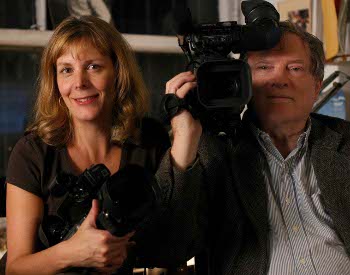
Filmmaker spoke with Pennebaker and Hegedus in their New York office earlier this month. Kings of Pastry opens at the Film Forum in New York City today.
Filmmaker: What was the genesis of this project?
Hegedus: Well, this project really came about because a friend of mine (Flora Lazar, co-producer) decided to move to Chicago. She went to the French Pastry School and really wanted to be a pastry chef. She told me about Jacquy Pfeiffer deciding to compete in this famous M.O.F. competition, and how his partner at the school, Sebastien [Canonne], had already competed [and won], and it just really sounded intriguing. So we flew out and met them. We met Jacquy and Sebastien. Once we heard about the competition, and the extreme nature of it, [we were] fascinated.
Pennebaker: [Jacquy] was sort of older, and he kind of had to do it. I liked him right away, and I thought, “This is the kind of person I’d like to film doing this.” So we just went to France with him and from then it was just hanging on and trying to figure out what we were doing.
Filmmaker: Was it difficult to obtain rights to film the M.O.F. competition?
Pennebaker: Well, in France, in August, nobody answers the phone. So no matter what you have in mind, you could call the police and get no answer! [laughs].
Hegedus: It was really through Sebastien, since he was already a M.O.F. and knew the organization, and had contacts there, and Jacquy knew them as well. But it was through his encouragement that we were able to contact the head people. And basically, we just had to convince them that we weren’t going to interfere, which is why at the end of each day, they would have to re-convene to see if we’d be allowed to shoot the next day [laughs]. It was a very risky situation, but they liked us.
Filmmaker: From the outside, the film seems like it would just be about a baking competition, but it really is about artisanship in general.
Hegedus: Yes, that’s basically what it is — an artisan field to an extreme degree. There are aspects in the pastry field where people start doing this elaborate artisan ornamentation to embellish their art form. And the chefs that they want at this level have to be able to do both, to cook perfectly, to be artistic to the degree of making sculptures, and make things that taste delicious, which is kind of an odd combination. Most people that work as glass sculptors don’t have to make something that tastes good [laughs].
Pennebaker: The competition between chefs here [in the U.S.] is quite different. It has to do with speed, and a certain kind of aspect of food, which is what you see on television. But at the M.O.F.s, it was like a club that you wanted to get into. You didn’t just win. A number of people got selected based on their abilities, and the rest would have to come back another time.
Filmmaker: The film keeps the audience in suspense, from the judges’ intense scrutiny to the precariousness of the fragile sugar sculptures. Was that kind of tension there while filmmaking?
Hegedus: Well, we really didn’t have any budget on this project because our access was at the last-minute. It was at a very low level, and because no one had ever been allowed permission to even look at it or film it, they were very nervous that we would do something that would cause something to break in any way. So we couldn’t use any booms or radio mikes. We basically had our cameras, no lights or anything. It was restricted filming, and by the third day, when everyone was going to be carrying their beautiful displays, they drew little boxes around each of the tables and the kitchens, and that’s where you could stand.
Pennebaker: Our camera equipment is like any home movie camera. In the competition, we didn’t do any sound, because wireless microphones would distort the readings on their little scales, which is very crucial to them. But it was a very simple kind of filming. I don’t think anybody really noticed us after the first ten minutes.
Filmmaker: Chris, you grew up with a baking legacy, between your grandfather’s tea rooms in the 1920s and making chocolates and ice creams, while your great-grandfather was a highly respected chef and cooked for the Roosevelts. Did you find a kinship with the chefs?
Hegedus: It was interesting to me because my grandfather, who came from Europe, apprenticed to a baker, and then came to the United States and created these pastry confectionary stores. But I think my real connection to the chefs is less from my grandfather, because he died before I knew him, but from my Hungarian grandmother, who was just such an exquisite chef. For me, that was interesting, because at a time when I grew up in the ’50s, cooking in America had turned away from the cooking roots of people’s families. It was the blossoming of all TV dinners and fast food. We almost lost the idea of cooking. [laughs] I did have this side of my family that was involved in this really exquisite cooking, where I would get these elaborate cakes. I never saw them anywhere else.
Filmmaker: How do you get subjects to be natural and comfortable in front of the camera?
Hegedus: I think for both people [famous and non-famous], it’s a matter of getting them to trust you. And if they see that you’re genuinely interested in what they do, that you take the time to really find out about what they do, they’ll slowly let you into their lives. But it’s a privilege, it’s not something that is given. And definitely, when things are going well, and however they envision the movie of their life, they’re happy to have you there. But when things aren’t going as planned, then it’s not the happiest moment to have you around. And I think in those moments, it’s very nice to have a partner. You feel very un-loved, you don’t know what to do, and it’s nice to have someone when you’re making a film at this point. It’s an adventure and a risk on both of our parts. I think that kind of bonds you in a certain way.
Pennebaker: The thing is, if people are uncomfortable in front of your camera, you better stop filming them. That’s why you don’t sit them down in a chair and ask them questions. It’s boring for everybody, so you try to avoid it. What you want to do is find out everything you want to know by seeing it happen. You don’t want to have them tell you about it, or have someone tell you about it. It’s kind of how documentaries began, because everybody couldn’t be there when the action took place. But if you work on it and think about it before you film, you sort of know how people are going to act, and that’s when you want to be filming. You want to be in the War Room when they win the election, not afterwards when they tell you about it.
Filmmaker: The chefs seem to hold more of a camaraderie with each other rather than a rivalry, and it was uplifting to watch. As well as the judging M.O.F.s who showed support to the contestants.
Pennebaker: Well, they all know each other. I mean, these are the best chefs in France, which is something. They were already working in restaurants that were heavy-duty, so it’s not like they’re trying to break into the [business]. They’re already there. It’s the kind of single effort on the part of a Frenchman to join a special group, like the Knights Templar. Anybody who was a Knights Templar was like the king, meaning he had access to the king. And this is back in the 1300s, and it’s prevailed, so it’s kind of like that.
Hegedus: It was incredibly supportive. I think they (the M.O.F.s) recognize that anybody who made it to that level of the competition, they’re all pretty good chefs. They know they should be part of their club, and it is an interesting club, these chefs who have the red, white, and blue collars. The idea of the M.O.F. was started 100 years ago to encourage excellence in the manual craft field, so a lot of it is about giving back. The chefs say that the hardest thing is that after you get the M.O.F., you have to be this role model for people and give back. I think that’s why the chefs came up to [the contestants] when they were having a hard time — that kind of mentoring and encouraging thing is part of what the M.O.F. is about, and I think that’s wonderful.
Filmmaker: Your documentaries have featured politics, music, and entertainment figures, like Carol Burnett, Al Franken, Bill Clinton, and Bob Dylan. Do you feel like you choose your subjects, or do they choose you?
Hegedus: I think most of our subjects come to us. Someone says, “I’d think it’d be good if you did a film about this, would you be interested?” If somebody has access, that’s the most important thing, but yes, people come to us, or hear about things that we’re interested in. When I did Startup.com, I was interested in the Internet, it seemed like this Wild West in front of us, and everybody wanted to be a part of it.
Filmmaker: Your films often have your subject in the middle of a project, be it a Broadway show, an election, a concert tour, or recording an album. Do you feel these situations reveal their personality more than an interview would?
Pennebaker: If you want to know what somebody’s like, if you want to get a sense of their character, you’ve got to get them when they’re going around a corner. In an election, that’s easy, because the corner is the election, but sometimes, it’s like with [the band] The National, they want to do a concert at BAM, which would go online. I thought it sounded like a marvelous idea — I’ve never done a live concert. So we all find out something, and it was a marvelous thing to do.
Filmmaker: How has finding funding changed over the years?
Hegedus: Funding was more difficult in the beginning because getting started on a major film was expensive. A roll of film had to be processed and a print made from it. A 10-minute roll cost two hundred and fifty dollars when you finally got it out of the lab. This meant that it was often necessary to try and sell the project before beginning it, which required a script or outline. It also meant that whoever put up “front” money really owned the film and could edit it as they saw fit. Not a good arrangement for filmmakers.
Most of our funding early on was borrowed, either from friends or relations, and of course they had to be paid back so it was almost obligatory that the project be salable not to TV that had little interest in independent filmmakers, but to theatrical distributors, or in most instances to theaters as a first run self-distributed film which was very hard to carry out. You certainly didn’t get rich. Don’t Look Back and Monterey Pop were examples of this, and while they were both extremely popular and each played theatrically for well over a year it was difficult to get the theaters to pay. The film of Steve Sondheim’s Company was never sold to a network but had to be parceled out to individual stations and paid for by piecework sales to sponsors. I don’t know if the producer made much money but we certainly didn’t.
Switch now to present: A serious project like The War Room or Kings of Pastry can be started with relatively little investment other than a small video camera and the time of the actual filmmakers. A simple video camera records high quality sound and picture and can be operated by a single person. Both of those films were shot without lights or an expensive crew. Filming over long periods of time, which is almost always required, is expensive but the film generally ends up belonging to the filmmakers, and much of the money to pay for it raised through funding organizations that give tax benefits to donors instead of promising profits from subsequent distribution.
Filmmaker: What are you working on next?
Hegedus: Next project, well, we’re never quite sure what’s next until we actually pick up a camera and start to shoot, but there is some talk about doing a film with Steve Sondheim, whom I have known for some time but not really well so it offers a chance to know him better and to do a
musical film which of course we would really like to do. Ask us in a couple of months and let’s see what brews. We are also following the activities at CERN and the possibilities for a film coming out of there or connected to it.