Sundance 2012
Friday, January 27th, 2012

Independent film, depending on how you define it, has had many births. But for the purposes of this blog post, let’s consider the one in the 1980s, just before the launch of this magazine. She’s Gotta Have It, Parting Glances, Poison, True Love — these were narrative features made by lone filmmakers with a mixture of private money and, sometimes, foreign TV deals, and they were released into the marketplace after being acquired by independent distributors who catered to arthouse audiences. More films followed — Clerks, El Mariachi, The Blair Witch Project — and the idea that one could possibly be not just a filmmaker but an “independent filmmaker” was born.
Of course, things change, and I wonder if a new generation for whom media creation is simply part of life even cares about that self-definition. Is making a movie that special anymore? Maybe the ones who really care about the meaning of “independent” are in other fields, like video games. Case in point: the creators profiled in Lisanne Pajot and James Swirsky’s Sundance documentary Indie Game, who evince all the blood, sweat and tears we like to claim as the hallmarks of the independent filmmaker. More importantly, they are creating games during a historical moment that feels both somewhat new and not unlike the rush that the filmmakers behind films like, say, The Blair Witch Project, must have felt when their homemade creations suddenly burst forth on 2,000 screens.
Pajot and Swirsky interviewed 25 game designers before narrowing their film’s focus to three. Braid creator Jonathan Blow (pictured above, at right, with Pajot and Swirsky at the Sundance Q&A) is the eminence grise, the obsessive elder statesman who revolutionized the indie game world with a work that was not only fun to play but emotionally rich. That an indie game could make such an impact, scoring mainstream reviews and selling in the hundreds of thousands of downloads, inspired the film’s other two game designers. Designer Edmund McMillen and programmer Tommy Refenes are the team behind Super Meat Boy, an anarchic … Read the rest
Friday, January 27th, 2012
The role of authority in the lives of everyday people is a crucial question at this year’s Sundance Film Festival. From the first wave of documentaries examining the Arab Spring to fictional accounts of the personal and collective consequences of confronting our conception of power, Sundance filmmakers this year have looked at the state of our world and our culture and uncovered a complex battle for control. Of the standout films I have seen at Sundance this year, for one reason or another, the issues of control and responsibility have played a crucial part in giving this edition of the festival its distinctly dystopian tenor; there is a decidedly downbeat feeling up here in the thin, frozen air, a sense that something is truly broken.
Front and center in my mind is Craig Zobel’s Compliance (above), a film that is inspiring a great deal of debate among viewers. The film tells the story of a young female employee at a fast food restaurant who, after her manager receives a phone call from a police officer, is subjected to confinement and, ultimately, physical and sexual humiliation at the hands of her employer. The film, which spends most of its time within the tight quarters of the restaurant manager’s office, is a study in Kafka-esque economy; a woman accused of a crime she may or may not have committed acquiesces to the abuse of her captors, who are themselves driven by a disembodied voice on the phone that exerts a perverse authority over their actions.
The film is deeply chilling, not just for what it proposes about human nature, but for Zobel’s extraordinary skill in creating a visual strategy that uses cinematic space to express the role playing and relative power of each of his characters in the frame. The result is a daisy chain of, well, compliance, with small clusters of authority and subordination recreated in the film’s geometry, giving a deep resonance to the film’s exploration of the brutality of capitalism in the era of Guantanamo.
Of course, not everyone sees the film this way; many have become fixated on the details of the story and the veracity … Read the rest
Friday, January 27th, 2012
During a ceremony held tonight at Park City’s Treasure Mountain Inn, prize winners were announced for the 18th annual Slamdance Film Festival. Taking home the Narrative Grand Jury Prize was Welcome to Pine Hill, Keith Miller’s vérité portrait of a reformed Brooklyn drug dealer undergoing a crisis of mortality. Meanwhile, Jens Pfeifer’s basketball documentary No Ashes, No Phoenix was awarded the Documentary Grand Jury Prize, while Caskey Ebeling’s Getting Up and Andrew Edison’s Bindlestiffs took home the Audience Awards for documentary and narrative, respectively.
The full list of winners, per The Hollywood Reporter:
AUDIENCE AWARDS
Audience Award for Feature Documentary: Getting Up by Caskey Ebeling
Audience Award for Feature Narrative: Bindlestiffs by Andrew Edison
GRAND JURY AWARDS – NARRATIVE
Grand Jury Sparky Award for Feature Narrative: Welcome to Pine Hill by Keith Miller, “for its poetic and emotionally honest depiction of one man’s final journey in life, crafted from a true spirit of humanity and community.”
Special Jury Award for Bold Originality: Heavy Girls by Axel Ranisch, “for its joie de vivre, an incredibly life-affirming film that is presented with a unique vision and an amazing cast.”
GRAND JURY AWARDS – DOCUMENTARY
Grand Jury Sparky Award for Feature Documentary: No Ashes, No Phoenix by Jens Pfeifer, “for its adeptly piercing and cinematic look at a basketball team’s impassioned struggle not for glory, but to just avoid losing.”
Grand Jury Sparky Award for Short Documentary: The Professional by Skylar Neilsen, for ”an honest and natural portrayal of work-as-life, and the slowly disappearing craft of an American working man.”
GRAND JURY AWARDS – SHORT FILMS
Grand Jury Sparky Award for Animation: Venus by Tor Fruergaard, “for its creative use of claymation characters to explore sexual adventure and its lighthearted, touching and memorable story.”
Grand Jury Sparky Award for Short Film: I Am John Wayne by Christina Choe, “for its unique storytelling, cinematography and performances, including the brilliant use of a real horse in an urban environment.”
Special Jury Prize for Experimental Short: Solipsist by Andrew Huang, “for its unique blend of live action footage of the human body, puppetry and computer animation that creates a colorful and insightful fantasy world.”
Honorable Mention for … Read the rest
No Comments
Category News, Sundance | Tags: Andrew Edison, bindlestiffs, Caskey Ebeling, Getting Up, Jens Pfeifer, Keith Miller, No Ashes No Phoenix, Sundance 2012, Weclome to Pine Hill,
Thursday, January 26th, 2012
If you’re attending Sundance, you undoubtedly have seen the orange jackets worn by the festival’s volunteers. They were designed by Kenneth Cole, the Sundance Institute board member who has been providing vests and jackets to the volunteers for eight years. In addition, Awearness, the Kenneth Cole Foundation, collaborated with Sundance on a comedic short written by Kenneth Cole Productions and produced and directed by Ricki Stern and Annie Sundberg (Joan Rivers: A Piece of Work, The Devil Came on Horseback). QR codes at the festival are prompting fest goers to stream the short on their mobile devices, and it played in front of all the films on the 25th. The short is below, and more info can be found on the Facebook page.
… Read the rest
Thursday, January 26th, 2012
There is a longstanding debate in the non-fiction filmmaking community about the nature of documentary films; is the mission of the documentary to tell the truth and nothing but or do the requirements of cinematic storytelling allow for flexibility in the service of story? As a passionate viewer of non-fiction filmmaking, I have always drawn a line between cinema and reportage; on the one hand, reality must provide the underlying structure of documentary film, but unlike news gathering and reporting, films should have the license to manipulate things like chronology and the way in which information is presented in order to create a cinematic reality. Great documentary films put an entire arsenal of cinematic effects to use in order to tell a great story — sound, music, editing, cinematography — but nothing is more important than a strong point of view, a storytelling perspective that allows for the creation of art.
Creating a balance between the information a story requires and the cinematic style that allows for the artful presentation of that information is the greatest challenge that most non-fiction filmmakers face. At this year’s Sundance, it is clear that, through the deployment of cheaper and smaller filmmaking technologies, artistry in non-fiction filmmaking has moved front and center. It is no longer enough to be an impassioned advocate for a cause or a subject; there are so many filmmakers who have developed into great visual storytellers that the bar has been raised to new and welcome heights.
At the top of the list for me at this year’s festival are two films that come down on opposite ends of traditional documentary storytelling, but each of which creates an intensely engaging cinematic experience for viewers. At one end of the spectrum, Malik Bendjelloul’s Searching For Sugar Man is the epitome of brilliant constructed documentary storytelling. The tale of forgotten 1970′s folk artist Sixto Rodriguez and the unexpected community of fans that love his music, Searching For Sugar Man had all of the potential in the world to be a traditional act of cultural reclamation from an admiring filmmaker. Instead, Bendjelloul uses gorgeous cinematography to establish location and tone, … Read the rest
Thursday, January 26th, 2012
I’ve been considering many cold opening quotes to this “During Sundance” blog ranging from, “Bagels again?” to, “Marina Abramovic is in the next bathroom stall!”
I’ll let Robert Redford start it with, “There’s Sundance here,” as he points towards the floor at the Directors Brunch “And then there’s Park City,” he indicates down the mountain.
“Park City is not Sundance.”
We directors nod. Bob understands. We won’t buy into the machine of the market place. Our film is already the gold and Bob is warning us to stay grounded.
We then instantly bum rush him as soon as his speech is over to speed gush and get a picture.
“Mr. Redford, I’m Erin Greenwell I just wanted to say when I was little I did a living history presentation of Butch Cassidy and the Sundance kid and I dressed up like a cowboy and nobody picked on me and I realized I wanted to make movies from that moment and I just wanted to say you are one of the reasons I’m standing here.”
Phew!
Redford radiates a godlike smile “I’m so glad you told me that. Where did you grow up, Erin?” “Missouri!” I blurt as our state flag, bird and motto flash through my head with pride. “May I get a picture with you?”
“Quick real quick” urges his handler, AND ear buds a jangle and hands trembling to the point of dropping my cell phone, I take three and mutter gratefully “Thanks thanks thanks” and step out of the circle.
Opening weekend is a fun and frightening haul. There are three circles of concern rotating through the “Park City” side of me. When is the next interview or photo op for my cast and crew, how’s the premier going to go and will we get a good Variety review?
At the premier, my producer, the AD and myself sit near the door. For every audience laugh, we fist bump. For every moment dropped, we shoot each other furtive glances. This goes on for the entire movie, punctuated by sudden victories “I didn’t think that would get a … Read the rest
Thursday, January 26th, 2012
Producer Nekisa Cooper (Pariah) and the IFP’s deputy director Amy Dotson joined Chicken & Egg Pictures in Park City to honor WMM‘s Debra Zimmerman with the 2012 Good Egg Award.
Director Josh Radnor spoke about his film Liberal Arts, his experiences at Kenyon College, and David Foster Wallace’s Infinite Jest.
Sarah Barnett, the EVP of the Sundance Channel, and Nancy Klasky Gribler, the EVP of Marketing for Sundance Cinemas, caught up at the Sundance Channel’s party.
The cast of the new Sundance Channel television show, Push Girls.
The director (Leslye Headland, far left) and cast of Bachelorette in one of the more raucous Q&A portions I’ve witnessed. Apparently some of the cast members (Rebel Wilson) had a bit too much to drink before the screening, and were finding it difficult to focus on the questions being asked. That’s okay though because Wilson made her love and respect for Headland obvious, while also admitting to loving Kirsten Dunst because she was in Bring It On.… Read the rest
No Comments
Category News, Sundance | Tags: Amy Dotson, Bachelorette, Debra Zimmerman, Josh Radnor, Leslye Headland, Nancy Klasky Gribler, Nekisa Cooper, Push Girls, Rebel Wilson, Sarah Barnett, Sundance 2012,
Thursday, January 26th, 2012

Here outside Zoom following BMI’s annual seat-switching dinner are elusive rock icon Rodriguez and Malik Bendjelloul, the director of his doc, Searching for Sugar Man. At the dinner, I asked Bendjellaul whether he was a fan of Rodrgiuez’s before the film. No, he said. He was looking for a story and hear about the Rodriguez saga from a private detective. The film was acquired at Sundance by Sony Pictures Classics.

Left behind after the Sundance premiere of Exit to the Gift Shop was this Banksy artwork, nicely framed by the good folks in Park City. Caught checking out the artwork are writer/director James Ponsoldt (Smashed) and Rev. Megan Holloway, whose “Vocation of the Storyteller” appeared in our Fall issue.

Writer/director David Lowery, one of our 2011 “25 New Faces,” was at Sundance following the January Screewriter’s Lab. Here he is at the Producer’s Brunch.

The Film Society of Lincoln Center’s Eugene Hernandez hosted a radio show at Sundance called The Daily Buzz. Here he is in the studio. You can download his podcasts here.

For several years the cut-through running from Main Street to Swede Alley by the Transit Center has been a spot for street performers. One singer/songwriter who made the trek to Park City this year was Natalie Gelman. Visit her website for merch, a show itinerary and more.… Read the rest
Thursday, January 26th, 2012
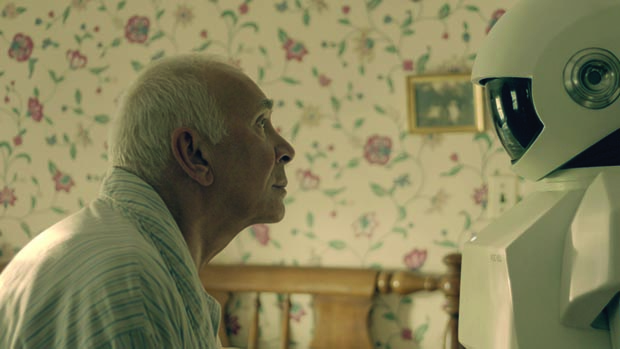
One of the hits of the 2012 Sundance Film Festival has been Robot and Frank, Jake Schreier’s tale of a retired jewel thief and the caretaker robot his kids purchase to assist him in his final days. In addition to Frank Langella, the film costars James Marsden, Susan Sarandon and Liv Tyler, and it was jointly acquired at the festival by Sony Pictures Worldwide Acquisitions and Samuel Goldwyn in a deal reported at over $2 million.
In addition to being a great actor, Langella is a great sport. Here he is being interviewed by the National Film Society.… Read the rest
Wednesday, January 25th, 2012
At a ceremony last night, Sundance announced this year’s short film prize winners. The 2012 shorts jury, which included Beavis and Butthead creator Mike Judge, Pariah director Dee Rees, and TIFF public program director Shane Smith, narrowed down the sixty-four shorts currently playing at the festival to six winners. The big winner was Cutter Hodierne’s fictional Somali pirate expose Fishing Without Nets, which took home the Jury Prize in Short Filmmaking. Meanwhile, Ben and Josh Sadie’s (Daddy Longlegs) The Black Balloon was awarded the US Fiction Prize while Kosovo filmmaker Blerta Zeqiri’s The Return (Kthimi) won the International Fiction Prize.
The Full list of Winners:

Jury Prize in Short Filmmaking: FISHING WITHOUT NETS / U.S.A. (Director: Cutter Hodierne, Screenwriters: Cutter Hodierne, John Hibey) — A story of pirates in Somalia, told from the perspective of the pirates themselves. Said the Short Film Jury of the film, “By approaching a story of epic scope with an intimate perspective, this visually stunning film creates a rare, inside point of view that humanizes a global story.”
Jury Prize in Short Film, U.S. Fiction: The Black Balloon / U.S.A. (Directors: Benny Safdie, Josh Safdie) — The Black Balloon strays from the herd and experiences what life as an individual is like. He explores New York City in the deepest way, seeing all of its characters.
Jury Prize in Short Film, International Fiction: The Return (Kthimi) / Kosovo (Director: Blerta Zeqiri, Screenwriter: Shefqet Gjocaj) — A man comes back from a Serb prison to his wife and son. Much has changed since he was declared missing and continuing where they left off four years ago may not be as easy as it seems.
Jury Prize in Short Film, Non-Fiction: The Tsunami and the Cherry Blossom / U.S.A. (Director: Lucy Walker) — Survivors in the areas hardest hit by Japan’s recent tsunami find the courage to revive and rebuild as cherry blossom season begins. A visual haiku about the ephemeral nature of life and the healing power of Japan’s most beloved flower.
Jury Prize in Animated Short Film:… Read the rest
3 Comments
Category News, Sundance | Tags: A Morning Stroll, Dee Rees, Fishing Without Nets, Mike Judge, Robots of Brixton, Sundance 2012, The Arm, the black balloon, The Return, The Tsunami and the Cherry Blossom,